 HalfTri
Half Ironman (70.3) training plan: a 16-week guide for beginners
Five phases, a week-by-week table, sample weeks and the small rules that keep a first 70.3 on track. Realistic hours, conservative distances, no heroics.
A half Ironman — 1.9 km of swimming, 90 km of cycling and a 21.1 km run — is a long day, but it is not a mysterious one. Most people who finish their first 70.3 do it on a plan that looks surprisingly ordinary: mostly easy training, a slow climb in hours, a few honest recovery weeks and a calm taper.
This is that plan, laid out over 16 weeks. It is written for beginners, so the numbers are deliberately conservative. You can always do a little more. It is much harder to undo doing too much.
Who this plan is for
Sixteen weeks is enough for a first half if you are not starting from zero. Before week 1, you should be able to:
- Swim 400 m continuously, in any stroke you like, without stopping at the wall for long.
- Ride for about an hour on a road bike or a trainer without it feeling like an emergency.
- Run for 30 to 40 minutes at an easy pace, or run/walk for that long comfortably.
- Find 5 to 6 hours a week at the start, growing to 9 to 11 hours for a few weeks near the end.
If one of those is missing, give yourself one or two extra months of easy, regular training first, and then start here. If you want the bigger picture on choosing a race and a timeline, start with how to plan your first half triathlon.
A quick health note: if you are new to exercise, returning after a long break, over 40 with no recent check-up, or have any heart, lung or joint condition, talk to a doctor before starting. This article is general guidance, not medical advice.
The 16 weeks, in five phases
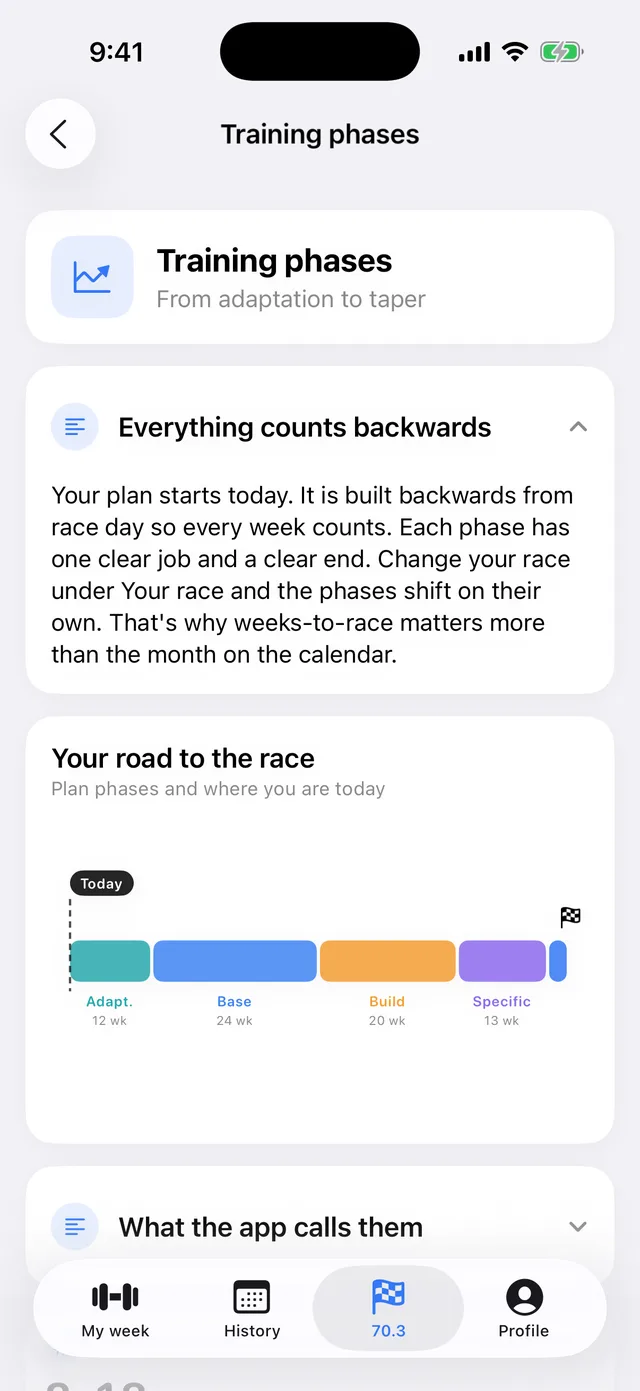
The plan counts backwards from race day. Each phase has one job:
- Adaptation (weeks 1–3). Get used to training three sports in the same week. Short, easy sessions. The goal is habit.
- Base (weeks 4–8). Build aerobic endurance. Long ride and long run grow slowly. Almost everything is easy.
- Build (weeks 9–12). Add some tempo and threshold work while volume keeps rising gently.
- Specific (weeks 13–14). Rehearse the race: long bricks, race-pace efforts, full nutrition practice.
- Taper (weeks 15–16). Cut volume, keep a little sharpness, arrive rested.
The plan, week by week
Hours are approximate totals across swim, bike, run and strength. Treat them as a ceiling, not a target you must hit.
| Week | Phase | Hours | Key sessions |
|---|---|---|---|
| 1 | Adaptation | ~5 | Long ride 1h · long run 40 min · 2 technique swims |
| 2 | Adaptation | ~5.5 | Long ride 1h15 · long run 45 min · swim 1,200 m |
| 3 | Adaptation | ~6 | Long ride 1h30 · long run 50 min · first short brick (bike + 10 min run) |
| 4 | Base | ~6.5 | Long ride 1h45 · long run 55 min · swim 1,500 m continuous-ish |
| 5 | Base | ~7 | Long ride 2h · long run 1h · 2 strength sessions |
| 6 | Base | ~7.5 | Long ride 2h15 · long run 1h05 · brick (1h30 bike + 15 min run) |
| 7 | Base (recovery) | ~5.5 | Long ride 1h30 · long run 45 min · easy everything |
| 8 | Base | ~8 | Long ride 2h30 · long run 1h15 · swim 1,900 m straight |
| 9 | Build | ~8.5 | Long ride 2h45 with tempo blocks · long run 1h20 · run intervals |
| 10 | Build | ~9.5 | Long ride 3h · long run 1h30 · brick (2h bike + 20 min run) |
| 11 | Build (recovery) | ~6.5 | Long ride 2h · long run 1h · open-water swim if possible |
| 12 | Build | ~10 | Long ride 3h15 · long run 1h40 · threshold bike intervals |
| 13 | Specific | ~10.5 | Brick 3h30 bike + 20 min run · long run 1h45 · race-pace swim |
| 14 | Specific | ~9.5 | Race rehearsal: 2h30 bike at race effort + 30 min run · long run 1h30 |
| 15 | Taper | ~6.5 | Long ride 1h30 with short race-pace blocks · long run 1h |
| 16 | Race week | ~3.5 + race | Short, sharp sessions early in the week · rest · race |
Notice what does not happen: you never swim, ride or run the full race distance in training. A 3.5-hour ride and a run of about 1h45 are enough for a first half. The taper and race-day adrenaline cover the rest.
If you'd rather not build and maintain this table yourself, HalfTri does it for you: pick your race and its date, and the app counts backwards, puts you in the right phase and lays out every week. If the race changes, the plan re-adjusts.
Intensity, explained simply
You do not need a power meter or lab-tested heart-rate zones to follow this plan. You need a feel for effort, on a scale of 1 to 10 (RPE, or rate of perceived exertion):
- Easy (RPE 3–4). Conversational. You can speak in full sentences. This is where 75–80% of your training lives. It should feel almost too easy.
- Tempo (RPE 5–6). Steady and focused. You can speak in short phrases. This is close to how a half Ironman bike should feel for most beginners.
- Threshold (RPE 7–8). Hard but controlled, the effort you could hold for about 40 to 60 minutes if you had to. Used in short blocks during the build phase only.
Anything above RPE 8 has almost no place in a first 70.3 plan. The most common beginner mistake is not training too little — it is training every session at a 6, which is too hard to recover from and too easy to make you faster.
What a week looks like in each phase
These sample weeks assume one full rest day and weekend long sessions. Swap days freely to fit your life; just keep the long ride and long run apart unless it is a planned brick. For more ideas on fitting this around work, see triathlon training with a full-time job.
Adaptation (week 2, ~5.5 h)
- Mon: rest.
- Tue: swim 30–40 min, technique drills + easy lengths.
- Wed: run 30 min easy + 20 min strength.
- Thu: bike 45 min easy.
- Fri: swim 30–40 min easy.
- Sat: long ride 1h15, easy.
- Sun: long run 45 min, easy (walk breaks are fine).
Base (week 6, ~7.5 h)
- Mon: rest.
- Tue: swim 45 min (e.g. 10 × 100 m steady with short rests) + 25 min strength.
- Wed: run 40 min easy with 4–6 short relaxed strides at the end.
- Thu: bike 1h easy, high cadence.
- Fri: swim 40 min easy + 20 min strength.
- Sat: brick: 1h30 easy ride, then 15 min easy run.
- Sun: long run 1h05, easy.
Build (week 10, ~9.5 h)
- Mon: rest.
- Tue: bike 1h15 with 3 × 10 min at threshold (RPE 7), easy between.
- Wed: swim 50 min with a main set at race effort + 20 min strength.
- Thu: run 50 min with 3 × 8 min at tempo (RPE 5–6).
- Fri: swim 40 min easy.
- Sat: brick: 2h ride with 2 × 20 min tempo, then 20 min run.
- Sun: long run 1h30, easy.
The long ride of 3h that week can replace Saturday's brick, or you can move it to Sunday and shorten the run; there are several honest ways to arrange a build week.
Specific (week 13, ~10.5 h)
- Mon: rest.
- Tue: swim 55 min, including 1,900 m continuous at race effort (open water if you can).
- Wed: bike 1h15 with 2 × 20 min at race effort.
- Thu: run 45 min easy + 20 min light strength.
- Fri: swim 40 min easy.
- Sat: long brick: 3h30 ride at easy-to-race effort, full race nutrition, then 20 min run.
- Sun: long run 1h45, easy (or Monday if Saturday was heavy).
Taper (week 15, ~6.5 h)
- Mon: rest.
- Tue: swim 40 min with a few short race-pace efforts.
- Wed: run 40 min with 3 × 5 min at race effort.
- Thu: bike 1h easy with 3 × 5 min at race effort.
- Fri: swim 30 min easy.
- Sat: long ride 1h30 with short race-pace blocks.
- Sun: long run 1h, easy.
Recovery weeks are part of the plan
Fitness is built during recovery, not during the workout itself. That is why weeks 7 and 11 drop by roughly a third, and why the adaptation block is followed by a gentle start to base. Every third or fourth week, you should feel like you are doing too little. That is the point.
During a recovery week, keep the frequency (you still swim, ride and run) but shorten everything and keep it easy. Sleep more. If you arrive at the next week feeling fresh and a bit restless, it worked.
Strength: short, simple, consistent
One or two sessions of 20 to 30 minutes a week are enough. Focus on the muscles that hold you together over hours: glutes, hips, core, calves and the back of the legs. Squats, split squats, hip hinges, bridges, planks and calf raises cover most of it.
Lift heavier in adaptation and base, maintain with lighter work in build and specific, and stop heavy lifting in the last 10 days. We go into detail in strength training for triathletes.
Bricks: teaching your legs the transition
A brick is a bike session followed immediately by a run. The first time, your legs will feel strange — heavy, wooden, slightly out of rhythm. That feeling fades with practice, which is exactly why bricks exist.
In this plan, bricks start small (10 minutes of running in week 3) and grow to 20–30 minutes off a long ride in the specific phase. You do not need long runs off the bike; you need your body to recognise the switch. Read more in brick workouts for triathlon.
Nutrition: practice on every long ride
Treat each long ride from week 5 onwards as a nutrition rehearsal. Start with around 30–40 g of carbohydrate per hour and, only if your stomach handles it, build gradually over the weeks toward 60–90 g per hour for the specific phase. Drink to thirst and adjust for heat.
By week 13, you should know exactly what you will eat and drink on race day, when, and how it feels at hour three. Nothing new on race day — not a gel, not a drink, not a breakfast.
What to do if you miss a week
It will happen. Work trips, colds, a sick child, a bad month. The rule is simple: do not try to make up lost training.
- Missed a few sessions: skip them and carry on. Protect the long ride and long run first.
- Missed a week for work or travel: resume where the calendar says you are, at the easy end of that week.
- Missed a week through illness: two or three easy days first, then repeat the last week you completed before moving on. If you had a fever or chest symptoms, get cleared before training hard again.
- Missed two weeks or more: consider whether the race date is still realistic. Pushing it back a few weeks is not failure.
The taper
The last two weeks are about arriving fresh, not getting fitter. Volume drops by around 30–40% in week 15 and further in race week, but you keep short bursts of race-pace effort so your body does not go flat. Expect to feel restless, a bit heavy, even doubtful. That is normal, and it is not a sign you need one more big session.
Race week
- Mon–Tue: a short swim, a short ride with a few race-pace efforts, and an easy 30-minute run.
- Wed–Thu: short, easy sessions or rest. Pack, check the bike, confirm logistics.
- Day before: 15–20 minutes of easy movement, bike check-in, early dinner of familiar food, early night.
- Race day: start slower than you want in every leg. Ride by effort, eat on schedule, and run the first 5 km easier than feels necessary.
For the full list of what to pack and check, see our triathlon race-day checklist.
Where HalfTri fits
Everything in this article can be done with a notebook and a calendar. HalfTri exists for people who would rather not. You pick a race — sprint, Olympic, 70.3 or full distance — and its date; the app counts backwards, places you in the right phase (adaptation, base, build, specific, taper) and lays out every week of gym, swim, bike and run sessions. If you change the race, the plan re-adjusts.
Strength days come with 700+ exercises shown in 3D with muscle maps, rest timers and a log of your last weights, and there is an Apple Watch companion. The race-day guides — nutrition, checklist, transitions and open water — work offline. It is free to download, with the race calendar and race-day guides included; HalfTri Pro unlocks the full plan, with 7 days free on the annual plan. An account is optional: without one, your data stays on your iPhone and in your iCloud.
FAQ
Is 16 weeks enough to train for a half Ironman?
For most beginners who can already swim 400 m continuously, ride for an hour and run for 30 to 40 minutes, yes. Sixteen weeks gives you time to adapt, build a base, add some intensity, rehearse the race and taper. If you are starting from zero, add a few months of easy, consistent training first.
How many hours a week do I need to train for a 70.3?
A conservative beginner plan starts around 5 to 6 hours a week and peaks around 9 to 11 hours for two or three weeks before the taper. Consistency across the 16 weeks matters far more than any single big week.
How long should my longest ride and run be?
For a first 70.3, a longest ride of about 3 to 3.5 hours and a longest run of about 1 hour 45 minutes to 2 hours is enough. You do not need to cover the full 90 km and 21.1 km in training.
What should I do if I miss a week of training?
Do not try to make it up. After illness, return with two or three easy days and repeat the previous week. After work or travel, if you feel healthy, simply continue with the plan at the easier end of the current week.
Do beginners need strength training for a half Ironman?
It helps. One or two short sessions a week for hips, glutes, core and the back of the legs can make long hours on the bike and on your feet feel more stable. Keep it simple and stop heavy lifting in the last 10 days.