 HalfTri
Triathlon race day checklist: what to bring and how to set up transition Checklist para el día del triatlón: qué llevar y cómo montar la transición
The fitness is already in the bank. What is left is logistics: a bag packed the night before, a transition you can find with your heart at 170, and a plan simple enough to follow when your head gets loud. La forma física ya la tienes. Lo que queda es logística: una bolsa hecha la noche anterior, una transición que encuentres con el corazón a 170 y un plan tan simple que puedas seguirlo cuando la cabeza empiece a hacer ruido.
Most first-timers do not lose time on race day because they are unfit. They lose it looking for a missing goggle strap, running the wrong way out of transition, or bonking at kilometre 60 because the gels stayed in the car. None of that is about training. All of it is about a list.
This is that list — the full triathlon packing list, grouped by leg, plus what to do the day before, a race-morning timeline, how to set up transition step by step and a pacing and fueling plan you can actually remember. It works for sprint, Olympic and 70.3. If you are still weeks out, start with how to plan your first half triathlon and come back here during taper week.
One honest caveat before we start: rules vary by event and federation. Wetsuit water-temperature limits, helmet rules, drafting distances, where your number goes, whether headphones or glass bottles are allowed — all of it changes from race to race. Your athlete guide is the final word. Read it twice.
The triathlon packing list, leg by leg
Pack by leg, not by drawer. Lay each group on the floor, tick it off, then put it in the bag. It sounds fussy. It is the single best way to not forget anything.
Swim
- Wetsuit, if the water temperature and the rules allow it
- Goggles, plus a spare pair (one clear or light, one tinted)
- Race swim cap (usually in your race pack) and your own cap to wear underneath if it is cold
- Anti-chafe balm for the neck and wrists
- Tri suit or whatever you will race in from start to finish
- Timing chip and strap
- Old flip-flops and a warm layer for the walk to the start
T1 (swim to bike)
- Small bright towel to mark your spot and stand on
- Helmet (it must be on and buckled before you touch your bike at most races)
- Sunglasses, stored inside the helmet
- Bike shoes (and socks only if you trained in them)
- Race number on a belt if your race requires it on the bike
Bike
- Bike, freshly checked: tyres, brakes, gears, chain lubed
- Bottles, filled with exactly what you trained with
- Nutrition taped to the top tube or in a bento box
- Spare tube, tyre levers, CO₂ or a mini pump, and a multi-tool
- Bike computer or watch, charged
- Floor pump for the morning (you can usually leave it with a friend or in your bag)
T2 (bike to run)
- Running shoes with elastic laces, already loosened
- Race belt with number (usually worn on the front for the run)
- Cap or visor
- Gel or chews for the first kilometres of the run
Run
- Socks, if you want them — pre-rolled so they go on in one move
- Watch set to show elapsed time and pace, nothing else
- Sunscreen already on, reapplied in T2 if the day is long
Nutrition
- Breakfast you have eaten before a long session at least three times
- A pre-start snack or gel for the last 15–30 minutes
- Bike and run fuel, counted out per hour
- Electrolytes or salt, especially if it will be hot
- A bottle to sip on during the morning
Documents and misc
- Photo ID and your race confirmation
- Race pack: numbers, stickers, wristband, chip
- Licence or day licence, if your federation requires it
- Safety pins, a spare race belt, a few zip ties and electrical tape
- Body glide, sunscreen, toilet paper (portable toilets run out)
- A clear plastic bag in case it rains on your transition
- Phone, charger, some cash and a head torch for dark mornings
After the race
- Dry clothes, including a warm top — you cool down fast
- Comfortable shoes or sandals
- A recovery snack and something salty
- A plastic bag for the wet wetsuit
The day before
The day before is for small errands and no heroics.
- Registration and bike check-in. Many races require you to rack your bike the day before. Bring your ID and race confirmation. Leave the tyres a bit soft if it will sit in the sun and pump them up in the morning.
- Athlete briefing. Go, even if you have read the guide. This is where you hear about last-minute course changes, the wetsuit decision and the penalty rules.
- Course recon. Walk the swim exit to your rack, your rack to bike-out, bike-in to your rack, and your rack to run-out. Look at the mount and dismount lines. If you can, drive or ride the first and last few kilometres of the bike course.
- A short shake-out. Fifteen to twenty minutes easy, with a few short pickups. Enough to feel your legs, not enough to tire them.
- Dinner. Early, familiar and carb-leaning. Rice, pasta, potatoes, bread. Go easy on fibre, fat and anything spicy. This is not the night to try the local speciality.
- Pack and lay out. Everything ready by the door, alarm set, bottles filled and in the fridge. Expect to sleep badly. The sleep that counts was the week before.
Race morning timeline
Work backwards from your start time. For a typical 7:00 start:
- About 3 hours before (4:00): wake up, drink water, eat your usual breakfast. Something like oats, toast with honey, a banana, coffee if you normally drink it.
- 2 hours before: leave for the venue. Use the toilet before you go.
- 90 to 60 minutes before: arrive when transition opens. Body marking, pump tyres, set up your spot (below). Check your bike computer and gears.
- 45 minutes before: walk the transition entrances and exits once more. Toilet queue. Transition often closes 30 to 45 minutes before the first start — check your guide.
- 30 minutes before: wetsuit on, halfway first, then fully. A few minutes of arm swings, band work or an easy jog.
- 15 minutes before: in-water warm-up if it is allowed — a few minutes of easy strokes and some faster ones. Otherwise, dry-land swim drills. Small gel or snack if that is your plan.
How to set up transition, step by step
Transition is the fourth discipline, and the easiest place to get free time. A good triathlon transition setup is small, logical and the same every time.
- Rack the bike by the saddle or the bars, as the race asks, in an easy gear so your first pedal strokes are light.
- Lay your towel on the ground beside the front wheel. Keep your footprint narrow; your neighbours need space too.
- Bike items at the front of the towel: helmet upside down with the straps open and sunglasses inside, then bike shoes. Number belt on top if you need it on the bike.
- Run items at the back: shoes with laces loosened, cap, run fuel.
- Nutrition and bottles already on the bike.
- Find a landmark for your row — a tree, a flag, a pole — because racks look identical when you are running in from the swim.
- Walk it twice: swim-in to rack to bike-out, then bike-in to rack to run-out. Count the rows.
Practice this at home in the week before the race. If you have done brick workouts, you already know how strange your legs feel off the bike; rehearsing the change itself removes the other half of the surprise.
Open-water start tips
- Seed yourself honestly. At rolling starts, stand with your expected finish time. At mass starts, go to the side or the back and let the chaos pass.
- Start slower than you want to. The first 200 metres decide how the rest of the swim feels. Breathe out fully and settle into a rhythm before you think about speed.
- Sight every 6 to 10 strokes. Lift your eyes just enough to see the buoy, then breathe to the side.
- If you panic, roll onto your back. Float, breathe, raise a hand if you need help. It is allowed, and it passes.
- Swim the last 100 metres with more kick so blood returns to your legs before you stand up.
A simple pacing and fueling plan
These are conservative, general starting points. If your coach or your training says otherwise, trust that.
- Sprint (about 1 to 1.5 hours). Hard but controlled from the start. Water on the bike is often enough; a gel before the start or on the bike if you like. Run the first kilometre controlled, then build.
- Olympic (about 2 to 3 hours). Swim smooth, ride at an effort you could hold for longer than the race, run the first 2 km slightly slower than goal pace. Around 30–60 g of carbs per hour on the bike, plus fluids.
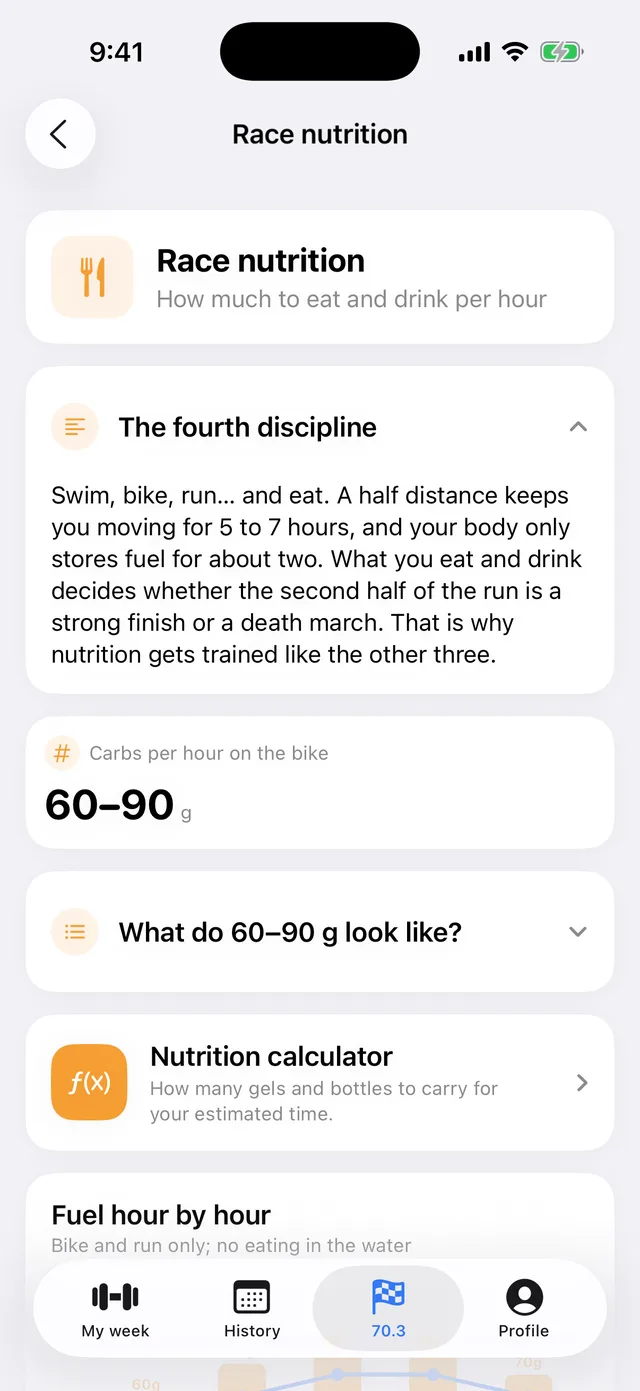
- 70.3 (about 4.5 to 7 hours). Ride at an effort where you can still speak in short sentences. Aim for 60–90 g of carbs per hour on the bike once you have practiced it in training, with fluids and electrolytes adjusted to the heat. Run the first 5 km slower than you feel you should, and keep taking a little at every aid station.
The rule that matters most: nothing new on race day. Not the gel, not the drink, not the shoes. The 16-week half Ironman training plan builds these rehearsals into the long rides for exactly this reason.
Common first-timer mistakes
- Starting the swim at someone else’s pace.
- Riding the first hour too hard because the legs feel fresh.
- Forgetting to eat on the bike until it is too late.
- Touching the bike before buckling the helmet, or mounting before the line — both are common penalties.
- Not knowing where your rack is.
- New shoes, new suit, new breakfast.
- Drafting without realising it. Most age-group races are non-drafting; learn the zone for yours.
Print this: the short version
- Swim: wetsuit, 2 goggles, cap, chip, anti-chafe.
- T1 and bike: helmet, sunglasses, shoes, bottles, nutrition, spare tube, pump.
- T2 and run: shoes, race belt, cap, gel.
- Docs: ID, race confirmation, numbers, pins.
- Timeline: breakfast 3 h out, arrive when transition opens, walk the flow twice, warm up.
- Plan: start easy, eat on the bike, run the first part slower than you feel.
FAQ
What should I bring to my first triathlon?
Pack by leg: swim (wetsuit if allowed, two pairs of goggles, race cap), bike (helmet, bike, shoes, bottles, spare tube and inflation), run (shoes with elastic laces, race belt, cap), plus tested nutrition, ID and race documents, a towel, sunscreen and warm clothes for after.
How early should I get to a triathlon on race morning?
Plan to arrive when transition opens, usually 60 to 90 minutes before your start. That covers parking, body marking, a calm setup, the toilet queue and a short warm-up. Your athlete guide has the exact times.
How do I set up my triathlon transition area?
Bike racked in an easy gear, towel beside the front wheel, helmet and bike shoes at the front, run shoes and race belt at the back. Then walk the route in and out twice so you can find your spot without thinking.
How much should I eat during a 70.3?
Many athletes aim for 60 to 90 g of carbs per hour on the bike, but only after practicing that amount in training. Keep taking small amounts on the run. Only use products you have tested.
Keeping it all in your pocket
Race venues are often lakes, parks and fields with a weak signal and thousands of phones on the same tower. That is why the race-day guides in HalfTri — nutrition, checklist, transitions and open water — work offline, so you can check your list on the grass by your rack.
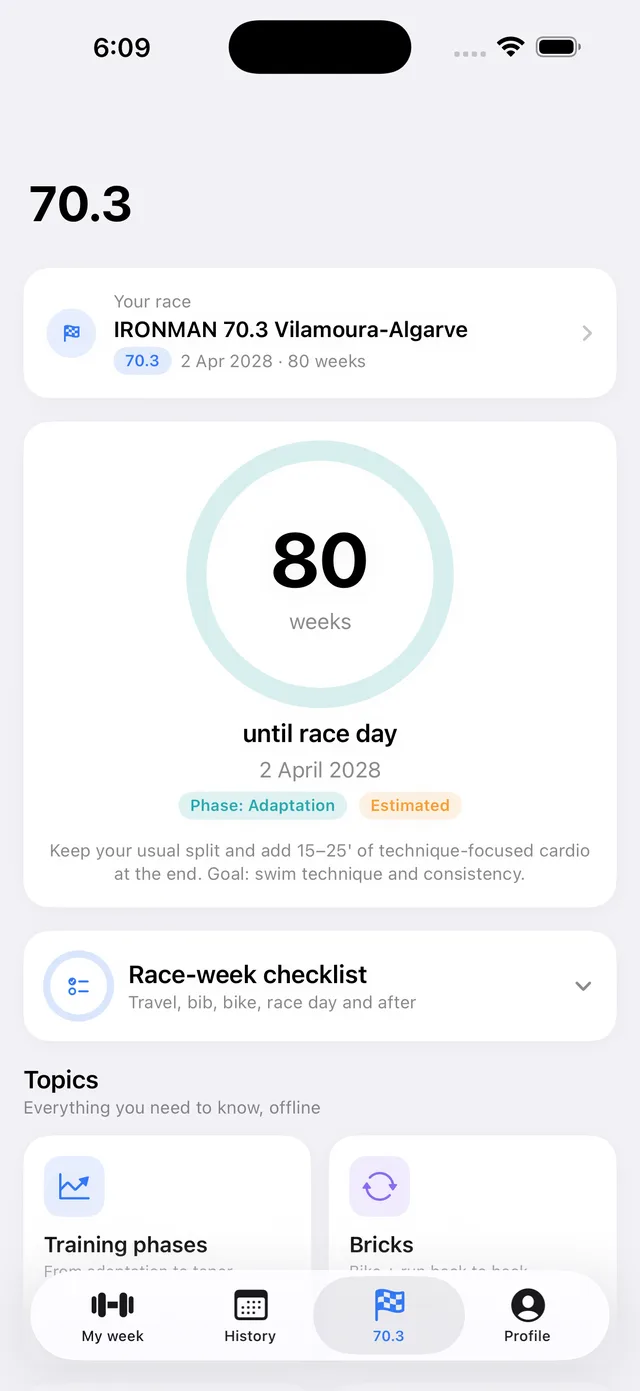
The rest of HalfTri is about getting you to the start line: pick a race (sprint, Olympic, 70.3 or full) and a date, and the app counts backwards, puts you in the right phase and lays out every week of gym, swim, bike and run sessions, with an Apple Watch companion. It is a one-time purchase with no subscription and no account; your data stays on your iPhone and in your iCloud.
Casi nadie pierde tiempo en su primer triatlón por falta de forma. Lo pierde buscando la correa de unas gafas, saliendo de la transición por el lado equivocado o quedándose sin gasolina en el kilómetro 60 porque los geles se quedaron en el coche. Nada de eso tiene que ver con el entrenamiento. Todo tiene que ver con una lista.
Esta es esa lista: todo lo que tienes que llevar, ordenado por segmento, más qué hacer el día antes, un horario para la mañana de la carrera, cómo montar la transición paso a paso y un plan de ritmo y alimentación que puedas recordar con el pulso alto. Sirve para sprint, olímpico y 70.3. Si todavía te quedan semanas, empieza por cómo planear tu primer medio triatlón y vuelve aquí en la semana del taper.
Un aviso honesto antes de empezar: las reglas cambian según la prueba y la federación. La temperatura del agua para usar neopreno, las normas del casco, la distancia de drafting, dónde va el dorsal, si se permiten auriculares o botellas de vidrio… todo varía de una carrera a otra. La guía del atleta tiene la última palabra. Léela dos veces.
Qué llevar a un triatlón, segmento por segmento
Prepara la bolsa por segmentos, no por cajones. Pon cada grupo en el suelo, márcalo y luego guárdalo. Parece exagerado, pero es la mejor manera de no olvidar nada.
Natación
- Neopreno, si la temperatura del agua y el reglamento lo permiten
- Gafas, y unas de repuesto (unas claras y otras oscuras)
- Gorro oficial (suele venir en la bolsa del corredor) y uno propio debajo si el agua está fría
- Crema o bálsamo antirozaduras para cuello y muñecas
- Tritraje o la ropa con la que vas a hacer toda la carrera
- Chip y su correa
- Chanclas viejas y algo de abrigo para ir hasta la salida
T1 (de nadar a la bici)
- Toalla pequeña y de color llamativo para marcar tu sitio
- Casco (en casi todas las pruebas tiene que estar puesto y abrochado antes de tocar la bici)
- Gafas de sol, guardadas dentro del casco
- Zapatillas de bici (y calcetines solo si entrenaste con ellos)
- Dorsal en un cinturón, si tu carrera lo exige en la bici
Bici
- La bici, revisada: neumáticos, frenos, cambios y cadena engrasada
- Bidones con exactamente lo mismo que usaste al entrenar
- Comida pegada al cuadro o en una bolsa de tubo superior
- Cámara de repuesto, desmontables, CO₂ o minibomba y multiherramienta
- Ciclocomputador o reloj, con batería
- Bomba de pie para la mañana (puedes dejársela a alguien o en la bolsa)
T2 (de la bici a correr)
- Zapatillas de correr con cordones elásticos, ya aflojados
- Cinturón portadorsal (en la carrera a pie el dorsal suele ir delante)
- Gorra o visera
- Un gel o gominolas para los primeros kilómetros
Carrera a pie
- Calcetines, si los quieres, ya enrollados para ponértelos de una vez
- Reloj configurado para ver tiempo total y ritmo, nada más
- Protector solar puesto desde la mañana y otra capa en la T2 si el día es largo
Nutrición
- Un desayuno que ya hayas probado al menos tres veces antes de una sesión larga
- Un snack o gel para los últimos 15–30 minutos antes de la salida
- La comida de bici y de carrera, contada por horas
- Electrolitos o sal, sobre todo si va a hacer calor
- Una botella para ir bebiendo durante la mañana
Documentos y varios
- Documento de identidad y confirmación de inscripción
- Bolsa del corredor: dorsales, pegatinas, pulsera y chip
- Licencia federativa o de un día, si tu federación la pide
- Imperdibles, un cinturón de repuesto, bridas y cinta aislante
- Vaselina, protector solar y papel higiénico (en los baños portátiles se acaba)
- Una bolsa de plástico por si llueve sobre tu transición
- Teléfono, cargador, algo de efectivo y un frontal si amanece tarde
Después de la carrera
- Ropa seca y algo de abrigo: el cuerpo se enfría rápido
- Calzado cómodo o sandalias
- Algo de comer para recuperar y algo salado
- Una bolsa para el neopreno mojado
El día antes
El día antes es para recados pequeños, no para demostrar nada.
- Recogida de dorsal y check-in de la bici. Muchas pruebas piden dejar la bici el día anterior. Lleva tu documento y la confirmación. Si va a pasar la noche al sol, deja las ruedas un poco bajas e ínflalas por la mañana.
- Charla técnica. Ve aunque te hayas leído la guía. Ahí se anuncian los cambios de recorrido de última hora, si se permite el neopreno y cómo funcionan las penalizaciones.
- Reconocimiento del recorrido. Camina desde la salida del agua hasta tu sitio, de tu sitio a la salida de bicis, de la entrada de bicis a tu sitio y de ahí a la salida a correr. Fíjate en las líneas de montaje y desmontaje. Si puedes, recorre los primeros y los últimos kilómetros de la bici.
- Una activación corta. De quince a veinte minutos suaves con algunos cambios de ritmo breves. Lo justo para sentir las piernas, no para cansarlas.
- La cena. Temprano, conocida y con bastantes hidratos: arroz, pasta, patata, pan. Poca fibra, poca grasa, nada picante. No es la noche de probar el plato típico del pueblo.
- Todo listo en la puerta. Bolsa hecha, alarma puesta, bidones llenos en la nevera. Lo normal es dormir mal; el sueño que cuenta es el de la semana anterior.
La mañana de la carrera, hora por hora
Cuenta hacia atrás desde tu hora de salida. Para una salida típica a las 7:00:
- Unas 3 horas antes (4:00): despiértate, bebe agua y toma tu desayuno de siempre. Por ejemplo avena, tostadas con miel, un plátano y café si lo tomas a diario.
- 2 horas antes: sal hacia la sede. Pasa por el baño antes de irte.
- Entre 90 y 60 minutos antes: llega cuando abra la transición. Marcaje, inflar ruedas y montar tu sitio (lo vemos abajo). Comprueba el ciclocomputador y los cambios.
- 45 minutos antes: recorre otra vez las entradas y salidas de la transición. Cola del baño. La transición suele cerrar entre 30 y 45 minutos antes de la primera salida; confírmalo en tu guía.
- 30 minutos antes: ponte el neopreno, primero hasta la cintura y luego entero. Unos minutos de movilidad de brazos, gomas o un trote suave.
- 15 minutos antes: calentamiento en el agua si está permitido: unos minutos suaves y algunas brazadas más rápidas. Si no, ejercicios de natación en seco. El gel o snack, si lo tenías previsto.
Cómo montar la transición paso a paso
La transición es la cuarta disciplina, y el sitio donde más fácil es ganar tiempo gratis. Una buena transición es pequeña, lógica y siempre igual.
- Cuelga la bici del sillín o del manillar, según pida la carrera, con un desarrollo suave para que las primeras pedaladas no cuesten.
- Pon la toalla en el suelo junto a la rueda delantera. Ocupa poco: tus vecinos también necesitan sitio.
- Lo de la bici, delante: casco boca abajo con las correas abiertas y las gafas de sol dentro, y luego las zapatillas de bici. El cinturón con el dorsal encima si lo necesitas en la bici.
- Lo de correr, detrás: zapatillas con los cordones sueltos, gorra y la comida para correr.
- Comida y bidones ya montados en la bici.
- Busca una referencia para tu fila — un árbol, una bandera, una farola — porque todas las barras parecen iguales cuando llegas corriendo del agua.
- Recórrelo dos veces: agua, tu sitio, salida de bicis; luego entrada de bicis, tu sitio, salida a correr. Cuenta las filas.
Ensáyalo en casa durante la semana previa. Si has hecho entrenamientos brick, ya sabes lo raras que se sienten las piernas al bajar de la bici; ensayar el cambio en sí te quita la otra mitad de la sorpresa.
Consejos para la salida en aguas abiertas
- Colócate con honestidad. En las salidas escalonadas, ponte con los de tu tiempo previsto. En las salidas en masa, ve por un lateral o atrás y deja pasar el caos.
- Empieza más lento de lo que te pide el cuerpo. Los primeros 200 metros deciden cómo te vas a sentir el resto del tramo. Suelta todo el aire y encuentra el ritmo antes de pensar en velocidad.
- Levanta la vista cada 6 a 10 brazadas. Solo los ojos, lo justo para ver la boya, y luego respira de lado.
- Si te agobias, ponte boca arriba. Flota, respira y levanta la mano si necesitas ayuda. Está permitido, y se pasa.
- Patea más en los últimos 100 metros para que la sangre vuelva a las piernas antes de ponerte de pie.
Un plan sencillo de ritmo y alimentación
Son puntos de partida generales y prudentes. Si tu entrenador o tus propios entrenamientos dicen otra cosa, hazles caso.
- Sprint (entre 1 y 1,5 horas). Fuerte pero controlado desde el principio. En la bici suele bastar con agua; un gel antes de la salida o en la bici si te sienta bien. Corre el primer kilómetro controlado y luego ve subiendo.
- Olímpico (entre 2 y 3 horas). Nadar fluido, rodar a un esfuerzo que podrías aguantar más tiempo que la propia carrera y correr los primeros 2 km algo más lento que tu ritmo objetivo. Unos 30–60 g de hidratos por hora en la bici, más líquidos.
- 70.3 (entre 4,5 y 7 horas). En la bici, un esfuerzo que te permita hablar con frases cortas. Apunta a 60–90 g de hidratos por hora cuando ya lo hayas practicado entrenando, con líquidos y electrolitos según el calor. Corre los primeros 5 km más lento de lo que crees que deberías y toma algo en cada avituallamiento.
La regla más importante: nada nuevo el día de la carrera. Ni el gel, ni la bebida, ni las zapatillas. El plan de 16 semanas para medio Ironman mete estos ensayos en las salidas largas justo por eso.
Errores típicos del debutante
- Salir a nadar al ritmo de otro.
- Ir demasiado fuerte la primera hora de bici porque las piernas se sienten frescas.
- Acordarte de comer en la bici cuando ya es tarde.
- Tocar la bici antes de abrocharte el casco, o montarte antes de la línea: dos penalizaciones muy comunes.
- No saber dónde está tu sitio en la transición.
- Zapatillas nuevas, tritraje nuevo, desayuno nuevo.
- Ir a rueda sin darte cuenta. La mayoría de pruebas de grupos de edad no permiten drafting; apréndete la zona de la tuya.
Para imprimir: la versión corta
- Natación: neopreno, 2 gafas, gorro, chip, antirozaduras.
- T1 y bici: casco, gafas de sol, zapatillas, bidones, comida, cámara, bomba.
- T2 y carrera: zapatillas, portadorsal, gorra, gel.
- Documentos: identificación, confirmación, dorsales, imperdibles.
- Horario: desayuno 3 h antes, llegar cuando abre la transición, recorrerla dos veces, calentar.
- Plan: empezar suave, comer en la bici, correr el principio más lento de lo que te pide el cuerpo.
Preguntas frecuentes
¿Qué llevo a mi primer triatlón?
Prepáralo por segmentos: natación (neopreno si se permite, dos gafas, gorro), bici (casco, bici, zapatillas, bidones, cámara y forma de inflar), carrera (zapatillas con cordones elásticos, portadorsal, gorra), más comida ya probada, documento y papeles de la inscripción, toalla, protector solar y ropa de abrigo para después.
¿Con cuánta antelación llego la mañana de la carrera?
Intenta llegar cuando abra la transición, normalmente entre 60 y 90 minutos antes de tu salida. Te da tiempo para aparcar, el marcaje, montar tu sitio con calma, la cola del baño y un calentamiento corto. Los horarios exactos están en la guía del atleta.
¿Cómo monto mi zona de transición?
Bici colgada con un desarrollo suave, toalla junto a la rueda delantera, casco y zapatillas de bici delante, zapatillas de correr y portadorsal detrás. Después recorre dos veces el camino de entrada y salida para encontrar tu sitio sin pensar.
¿Cuánto como durante un 70.3?
Muchos triatletas apuntan a 60–90 g de hidratos por hora en la bici, pero solo después de haber practicado esa cantidad entrenando. En la carrera a pie, sigue tomando poco en cada avituallamiento. Usa solo productos que ya hayas probado.
Todo en el bolsillo
Las sedes de triatlón suelen ser lagos, parques y explanadas con poca cobertura y miles de teléfonos en la misma antena. Por eso las guías del día de carrera de HalfTri — nutrición, checklist, transiciones y aguas abiertas — funcionan sin conexión, y puedes repasar tu lista sentado en el césped junto a tu bici.
El resto de HalfTri sirve para llegar bien a la línea de salida: eliges una carrera (sprint, olímpico, 70.3 o distancia completa) y una fecha, y la app cuenta hacia atrás, te ubica en la fase correcta y te arma cada semana con sesiones de gimnasio, natación, bici y carrera, con compañero para Apple Watch. Es un solo pago, sin suscripción y sin cuenta; tus datos se quedan en tu iPhone y en tu iCloud.