 HalfTri
Brick workouts: how to train the bike-to-run for triathlon Entrenamientos brick: cómo entrenar el paso de la bici a la carrera
The first kilometre off the bike is where a lot of triathlons quietly go wrong. Here is what a brick workout is, why your legs feel like someone else's, and six sessions that teach them to run anyway. El primer kilómetro después de la bici es donde muchos triatlones se tuercen sin hacer ruido. Aquí va qué es un brick, por qué tus piernas parecen de otra persona y seis sesiones para enseñarles a correr igual.
Every triathlete remembers their first run off the bike. You rack the bike, pull on your shoes, start jogging, and your legs feel like they belong to a wooden puppet. Your stride is short, your pace watch says something flattering, and your body says something else entirely. A few minutes later, it passes. Mostly.
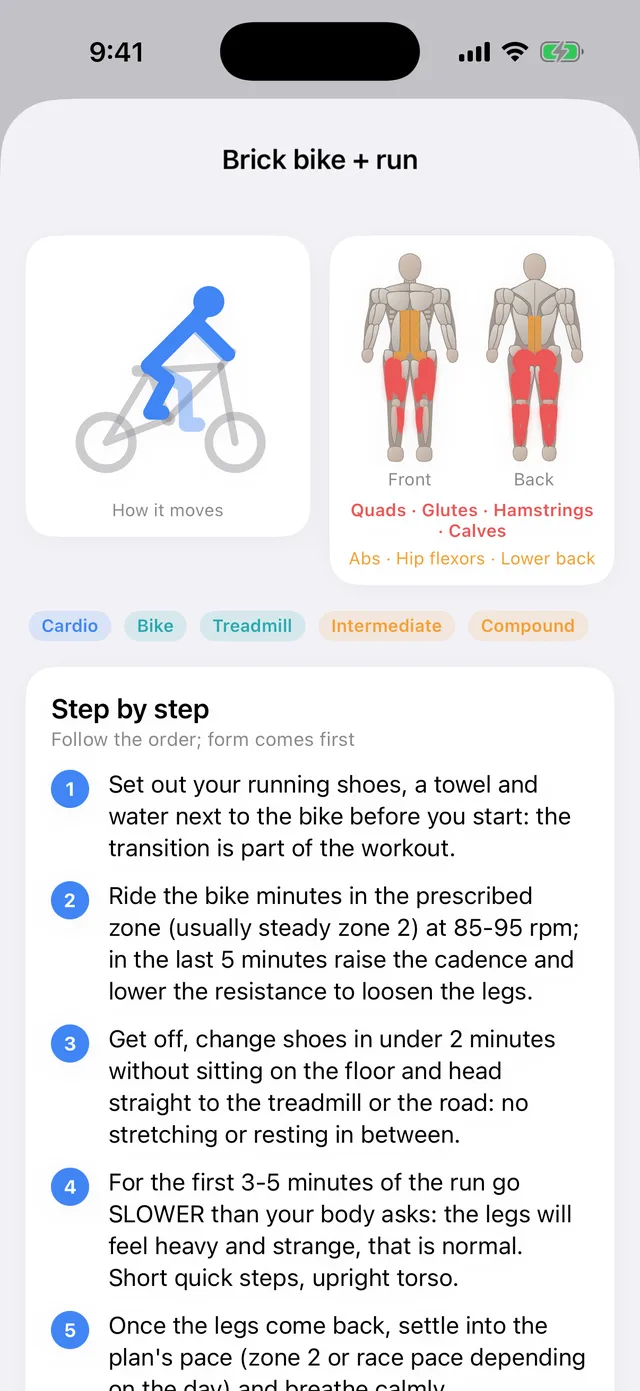
That feeling is the reason brick workouts exist. A brick is simply two disciplines done back to back with little or no break between them — almost always bike then run. It is the most triathlon-specific session you can do, and one of the easiest to get wrong by doing too much of it.
What a brick workout is (and why "jelly legs" happen)
The name has a few folk explanations — legs as heavy as bricks, or sessions stacked like bricks — and none of them matter much. What matters is the idea: you practise the change between sports under fatigue, because on race day you will not get a rest in between.
Why the legs feel so strange comes down to a few things happening at once:
- Different muscle patterns. Cycling is mostly concentric work in a fixed, seated position, with a lot of quad. Running adds impact, a longer hip extension and more glute and calf. Your nervous system needs a few minutes to switch programs.
- Blood where it was needed a moment ago. After an hour or more on the bike, blood flow has been favouring the muscles you were just using. Redistributing it takes time.
- Cadence mismatch. Your legs are used to spinning at one rhythm, and running asks for another. The result is often a choppy stride and a pace that feels much harder than it is — or, just as often, one that is much faster than you realise.
None of this can be skipped. What you can do is make it shorter and less alarming, and learn to run sensibly through it. That is what bricks train.
How often to do bricks
More is not better here. A brick is a hard day for the legs, and a run off the bike carries more injury risk than a run on fresh legs. Think of bricks as a skill session with a fitness bonus, not the backbone of your running.
- Sprint and Olympic. One short brick a week in the last 6 to 8 weeks is plenty. Before that, an occasional 10-minute run after an easy ride is enough.
- 70.3. One brick every 7 to 14 days through the build and specific phases. If you want the full picture of where they fit, our 16-week half Ironman training plan lays out the weeks.
- Full distance. A similar frequency, with longer bike portions and runs that still stay relatively short.
By phase, the pattern is simple. In base, bricks are short and easy: you are just introducing the sensation. In build, the bike portion gets harder and the run gets a little longer. In the specific phase, bricks start to look like the race — race effort, race nutrition, race kit. In the taper, you keep one short, sharp brick to remind the legs, and nothing long. If you are still working out the phases themselves, start with how to plan your first half triathlon.
Six brick workouts, from first-timer to race-specific
Efforts below use a simple scale: easy is fully conversational, steady is comfortable but focused, and race effort is the pace you expect to hold on race day for that distance.
1. The first brick: 45' easy bike + 10' easy run
Ride 45 minutes easy. Change shoes without rushing. Run 10 minutes at a truly easy effort, walking for 30 seconds if you need to. The only goal is to notice what the first five minutes feel like and to stay calm through them. Do this two or three times in the base phase and you have already removed most of the surprise.
2. The steady brick: 60–75' bike with 15' steady + 15–20' run
Ride an hour or so easy, with the last 15 minutes at steady effort so you arrive at the run with some fatigue. Run 15 to 20 minutes: the first 5 easy, the rest steady. This is the workhorse brick for early build, and the one most people can fit into a weekday evening.
3. The race-effort brick: 90' bike with last 20' at race effort + 20' run
Ride 90 minutes, mostly easy to steady, with the final 20 minutes at race effort. Go straight into a 20-minute run: the first 10 at your planned race-day run effort, then relax. The lesson here is restraint — most athletes discover they come off the bike 15 to 30 seconds per kilometre faster than they meant to.
4. Short multi-rep bricks: 3–4 × (15' bike + 5' run)
Best on an indoor trainer near a treadmill, or a trainer at home with a loop outside the door. Ride 15 minutes at steady to race effort, run 5 minutes at race effort, and go straight back on the bike. Repeat three or four times. Each rep is another transition, so you get four "first kilometres" in one session. It is surprisingly hard, and very effective in the build phase.
5. The swim-bike brick: 30–40' swim + 60' bike
Less talked about, but useful, especially if you race in a wetsuit. Swim 30 to 40 minutes with the last 10 at race effort, then get on the bike within 15 minutes and ride an hour easy to steady. You will notice the heart rate spike and the tight back in the first ten minutes. Practising it means you will not panic about it on race day.
6. The race-specific long brick: 2.5–3.5 h bike + 30–45' run
For 70.3 and full-distance athletes in the specific phase, two to four weeks out from the taper. Ride 2.5 to 3.5 hours with at least half of it at race effort, eating and drinking exactly as you will on race day. Run 30 to 45 minutes at race effort. Treat it as a dress rehearsal: same kit, same breakfast, same bottles. Do this once, maybe twice, and not in the final 10 days.
Progression by phase
Put together, a sensible progression for a 70.3 might look like this: two or three first bricks in base; steady and multi-rep bricks alternating through build; race-effort bricks moving into the specific phase with one long race-specific brick at the peak; and one short brick of 30 to 40 minutes on the bike plus 10 minutes of run in taper week. Build either the bike or the run portion from one brick to the next, not both at once.
Practise transitions at home
A brick is also the cheapest transition practice you will ever get. Set up a small "T2" at home: a towel, your running shoes with elastic laces, race belt, cap and a gel. Every brick, time yourself from stepping off the bike to starting the run. It feels silly the first time. By the fifth, you will do it without thinking, and that is exactly the point. Our triathlon race-day checklist covers what should be in that bag.
The cadence tip for the first kilometre
If there is one habit worth taking from this article, it is this: for the first kilometre off the bike, shorten your stride and quicken your steps. Aim for light, fast feet — a cadence similar to or slightly higher than your normal run — and let the stride length come back on its own after a few minutes. A long, reaching stride on tired legs is how pace gets away from you and how calves cramp.
A helpful companion to that: spin a slightly easier gear with a higher cadence in the last few minutes of the ride. It lightens the load on your legs just before you ask them to change jobs.
Nutrition in long bricks
Long bricks are the best place to test race nutrition, because they recreate the real problem: eating on the bike and then asking your stomach to cope with running. Take in carbohydrates from early in the ride, not once you are hungry, and build towards the amount you plan to use on race day. Keep taking on a little in the last 20 minutes of the ride, because the run is where you pay for what you skipped. On the run itself, try the same gel or drink you will use at the race. If something upsets your stomach, you have learned something valuable in training rather than at kilometre 12 of the half marathon.
Common mistakes
- Making every brick a long run. The value is in the first 10 to 20 minutes. A long run off the bike adds fatigue and risk faster than it adds fitness.
- Chasing pace off the bike. Run by effort for the first kilometre or two. Your watch will lie to you, and so will your legs.
- Bricks the day before your long run. Space them out so the key sessions of the week can actually land.
- Skipping the easy bricks. The short, boring ones in base are what make the hard ones in build feel manageable.
- A big brick in taper week. Keep it short and sharp. Fitness is already in the bank.
FAQ
How long should a brick run be?
Shorter than you think. For most age-groupers, 10 to 30 minutes off the bike is enough to teach the transition. Long runs belong on fresh legs. Even for a 70.3 or full distance, a brick run rarely needs to go past 45 to 60 minutes.
How many brick workouts should I do before a triathlon?
For a sprint or Olympic, one short brick a week in the last 6 to 8 weeks. For a 70.3, one every 7 to 14 days through build and specific phases, which usually adds up to 8 to 12 in total. For a full distance, a similar count with longer bike portions, and no big brick in the final 10 days.
Do jelly legs ever go away?
They get much smaller. Experienced triathletes still feel them, but with regular bricks the awkward phase usually shrinks from ten minutes to two or three, and you learn not to panic or chase pace while it passes.
Can I do a brick on an indoor trainer and treadmill?
Yes, and it is one of the most practical ways to do them. The transition is a few steps away, which makes short multi-rep bricks easy to fit into a weekday.
Where HalfTri fits
Knowing that bricks belong in build and specific phases is the easy part; remembering to schedule them at the right moment, week after week, is harder. In HalfTri you pick a race — sprint, Olympic, 70.3 or full distance — and its date. The app counts backwards, places you in the right phase and lays out every week, brick sessions included, alongside your gym, swim, bike and run days. Change the race and the plan re-adjusts.
The race-day guides on nutrition, transitions, open water and the checklist live inside the app and work offline, and there is an Apple Watch companion for the sessions themselves. It is a one-time purchase, with no subscription and no account; your data stays on your iPhone and in your iCloud.
Todo triatleta recuerda la primera vez que corrió después de la bici. Cuelgas la bici, te pones las zapatillas, empiezas a trotar y las piernas parecen de un títere de madera. La zancada es cortísima, el reloj marca un ritmo que te halaga y el cuerpo te dice otra cosa muy distinta. A los pocos minutos se pasa. Casi del todo.
Esa sensación es la razón de ser del brick. Un brick es simplemente hacer dos disciplinas seguidas, sin descanso o casi sin él — casi siempre bici y luego carrera a pie. Es la sesión más específica de triatlón que existe, y una de las más fáciles de hacer mal por pasarte con ella.
Qué es un brick (y por qué te quedan las piernas de gelatina)
Sobre el nombre hay varias teorías — piernas pesadas como ladrillos, sesiones apiladas como ladrillos — y ninguna importa demasiado. Lo que importa es la idea: practicar el cambio de deporte con fatiga encima, porque el día de la carrera nadie te va a dar un descanso entre medias.
La sensación rara en las piernas viene de varias cosas a la vez:
- Patrones musculares distintos. Pedalear es sobre todo trabajo concéntrico, sentado, en una postura fija y con mucho cuádriceps. Correr añade impacto, una extensión de cadera más larga y más glúteo y gemelo. Tu sistema nervioso necesita unos minutos para cambiar de programa.
- La sangre, donde hacía falta hace un momento. Después de una hora o más en la bici, el flujo sanguíneo ha estado priorizando los músculos que acabas de usar. Redistribuirlo lleva su tiempo.
- Cadencia descolocada. Tus piernas vienen acostumbradas a girar a un ritmo y correr les pide otro. El resultado suele ser una zancada torpe y un ritmo que se siente mucho más duro de lo que es — o, igual de a menudo, mucho más rápido de lo que crees.
Nada de esto se puede saltar. Lo que sí puedes hacer es que dure menos, que asuste menos y aprender a correr con sensatez mientras pasa. Eso es lo que entrena un brick.
Cada cuánto hacer bricks
Aquí más no es mejor. Un brick es un día duro para las piernas, y correr después de la bici tiene más riesgo de lesión que correr fresco. Piensa en el brick como una sesión de habilidad con premio físico, no como la base de tu carrera a pie.
- Sprint y olímpico. Un brick corto por semana en las últimas 6 a 8 semanas es más que suficiente. Antes de eso, correr 10 minutos de vez en cuando después de una salida suave basta.
- 70.3. Un brick cada 7 a 14 días durante las fases de construcción y específica. Si quieres ver dónde encajan semana a semana, nuestro plan de 16 semanas para medio Ironman lo desglosa.
- Distancia completa. Una frecuencia parecida, con bici más larga y carreras que siguen siendo relativamente cortas.
Por fases, el patrón es sencillo. En base, bricks cortos y suaves: solo estás presentándole la sensación al cuerpo. En construcción, la parte de bici se endurece y la carrera se alarga un poco. En la fase específica, los bricks empiezan a parecerse a la carrera: esfuerzo de carrera, nutrición de carrera, equipo de carrera. En el taper, te quedas con un brick corto y vivo para recordarle a las piernas, y nada largo. Si todavía estás entendiendo las fases en sí, empieza por cómo planear tu primer medio triatlón.
Seis bricks, de debutante a específico de carrera
Los esfuerzos usan una escala simple: suave es poder hablar sin problema, sostenido es cómodo pero concentrado, y esfuerzo de carrera es el ritmo que esperas mantener ese día en esa distancia.
1. El primer brick: 45' de bici suave + 10' de carrera suave
Rueda 45 minutos suave. Cámbiate de zapatillas sin prisa. Corre 10 minutos a un ritmo de verdad suave, caminando 30 segundos si lo necesitas. El único objetivo es notar cómo se sienten los primeros cinco minutos y mantener la calma mientras duran. Hazlo dos o tres veces en la fase de base y ya te habrás quitado casi toda la sorpresa.
2. El brick sostenido: 60–75' de bici con 15' sostenidos + 15–20' de carrera
Rueda más o menos una hora suave, con los últimos 15 minutos a esfuerzo sostenido para llegar a la carrera con algo de fatiga. Corre 15 a 20 minutos: los primeros 5 suaves y el resto sostenido. Es el brick de batalla del inicio de la construcción, y el que casi cualquiera puede meter en una tarde entre semana.
3. El brick a esfuerzo de carrera: 90' de bici con los últimos 20' a ritmo de carrera + 20' de carrera
Rueda 90 minutos, casi todo entre suave y sostenido, con los 20 finales a esfuerzo de carrera. Pasa directo a correr 20 minutos: los primeros 10 al esfuerzo que tienes planeado para la carrera, luego afloja. La lección aquí es contenerte — casi todo el mundo descubre que baja de la bici corriendo 15 a 30 segundos por kilómetro más rápido de lo que quería.
4. Bricks cortos por repeticiones: 3–4 × (15' de bici + 5' de carrera)
Ideal con rodillo cerca de una cinta, o con el rodillo en casa y una vuelta a la manzana. Rueda 15 minutos entre sostenido y esfuerzo de carrera, corre 5 minutos a esfuerzo de carrera y vuelve directo a la bici. Repite tres o cuatro veces. Cada repetición es otra transición, así que te llevas cuatro "primeros kilómetros" en una sola sesión. Es más duro de lo que parece y muy efectivo en la construcción.
5. El brick natación-bici: 30–40' de natación + 60' de bici
Se habla menos de él, pero sirve, sobre todo si compites con neopreno. Nada 30 a 40 minutos con los últimos 10 a esfuerzo de carrera, súbete a la bici en menos de 15 minutos y rueda una hora entre suave y sostenido. Vas a notar el pico de pulsaciones y la espalda rígida los primeros diez minutos. Si lo practicas, el día de la carrera no te va a asustar.
6. El brick largo específico: 2,5–3,5 h de bici + 30–45' de carrera
Para 70.3 y distancia completa, en la fase específica, dos a cuatro semanas antes del taper. Rueda 2,5 a 3,5 horas con al menos la mitad a esfuerzo de carrera, comiendo y bebiendo exactamente como lo harás ese día. Corre 30 a 45 minutos a esfuerzo de carrera. Tómalo como un ensayo general: mismo equipo, mismo desayuno, mismos bidones. Una vez, quizá dos, y nunca en los últimos 10 días.
Progresión por fases
Juntándolo todo, una progresión sensata para un 70.3 podría ser así: dos o tres primeros bricks en base; bricks sostenidos y por repeticiones alternándose en construcción; bricks a esfuerzo de carrera al entrar en la fase específica, con un brick largo específico en el pico; y en la semana de taper, un brick corto de 30 a 40 minutos de bici más 10 de carrera. De un brick al siguiente, alarga la bici o la carrera, no las dos a la vez.
Practica las transiciones en casa
Un brick es también la práctica de transiciones más barata que vas a tener. Monta una pequeña "T2" en casa: una toalla, las zapatillas con cordones elásticos, el cinturón porta-dorsal, la gorra y un gel. En cada brick, cronométrate desde que te bajas de la bici hasta que empiezas a correr. La primera vez te sentirás ridículo. A la quinta lo harás sin pensar, que es justo lo que buscas. En nuestra checklist del día de carrera tienes lo que debería ir en esa bolsa.
El truco de cadencia para el primer kilómetro
Si te quedas con un solo hábito de este artículo, que sea este: en el primer kilómetro después de la bici, acorta la zancada y acelera los pasos. Busca pies ligeros y rápidos — una cadencia parecida o un poco más alta que la de tu carrera normal — y deja que la amplitud vuelva sola a los pocos minutos. Una zancada larga, estirándote con las piernas cansadas, es la forma más rápida de que se te escape el ritmo y de acabar con un calambre en el gemelo.
Un buen complemento: en los últimos minutos de la bici, mete un piñón más suave y sube la cadencia. Descargas un poco las piernas justo antes de pedirles que cambien de oficio.
Nutrición en los bricks largos
Los bricks largos son el mejor sitio para probar la nutrición de carrera, porque reproducen el problema real: comer en la bici y luego pedirle al estómago que aguante corriendo. Empieza a tomar carbohidratos pronto, no cuando ya tengas hambre, y ve subiendo hasta la cantidad que piensas usar el día de la carrera. Sigue tomando un poco en los últimos 20 minutos de bici, porque lo que te saltes lo pagas corriendo. Ya en la carrera, prueba el mismo gel o bebida que usarás en la competición. Si algo te sienta mal, lo has descubierto entrenando y no en el kilómetro 12 del medio maratón.
Errores comunes
- Convertir cada brick en una tirada larga. El valor está en los primeros 10 a 20 minutos. Correr largo después de la bici suma fatiga y riesgo más rápido de lo que suma forma.
- Perseguir el ritmo al bajar de la bici. Corre por sensaciones el primer kilómetro o dos. El reloj te va a mentir, y las piernas también.
- Brick el día antes de tu tirada larga. Sepáralos para que las sesiones clave de la semana de verdad aterricen.
- Saltarte los bricks fáciles. Los cortos y aburridos de la base son los que hacen que los duros de la construcción se sientan manejables.
- Un brick grande en la semana de taper. Corto y vivo. La forma ya está en el banco.
Preguntas frecuentes
¿Cuánto debe durar la carrera de un brick?
Menos de lo que crees. Para la mayoría de amateurs, entre 10 y 30 minutos después de la bici bastan para aprender la transición. Las tiradas largas, con piernas frescas. Incluso para un 70.3 o una distancia completa, la carrera de un brick rara vez necesita pasar de 45 a 60 minutos.
¿Cuántos bricks debería hacer antes de un triatlón?
Para sprint u olímpico, un brick corto por semana en las últimas 6 a 8 semanas. Para un 70.3, uno cada 7 a 14 días durante construcción y fase específica, que suele sumar entre 8 y 12 en total. Para distancia completa, una cantidad parecida con más bici, y ningún brick grande en los últimos 10 días.
¿Las piernas de gelatina desaparecen alguna vez?
Se hacen mucho más pequeñas. Los triatletas con experiencia también las sienten, pero con bricks regulares esa fase torpe suele pasar de diez minutos a dos o tres, y aprendes a no entrar en pánico ni perseguir el ritmo mientras dura.
¿Puedo hacer un brick con rodillo y cinta?
Sí, y es de las formas más prácticas de hacerlos. La transición está a dos pasos, así que los bricks cortos por repeticiones caben sin problema en un día entre semana.
Dónde encaja HalfTri
Saber que los bricks van en construcción y en la fase específica es lo fácil; acordarte de programarlos en el momento justo, semana tras semana, cuesta más. En HalfTri eliges una carrera — sprint, olímpico, 70.3 o distancia completa — y su fecha. La app cuenta hacia atrás, te ubica en la fase correcta y te arma cada semana, bricks incluidos, junto con tus días de gimnasio, natación, bici y carrera. Si cambias de carrera, el plan se reajusta.
Las guías del día de carrera — nutrición, transiciones, aguas abiertas y checklist — viven dentro de la app y funcionan sin conexión, y tienes un compañero de Apple Watch para las sesiones. Es un solo pago, sin suscripción y sin cuentas; tus datos se quedan en tu iPhone y en tu iCloud.