 HalfTri
Strength training for triathletes: exercises and a simple gym plan
You do not need to become a lifter. You need two short, boring sessions a week that keep your hips, back and calves ready for hours of swimming, riding and running. Here is exactly what to do, and when.
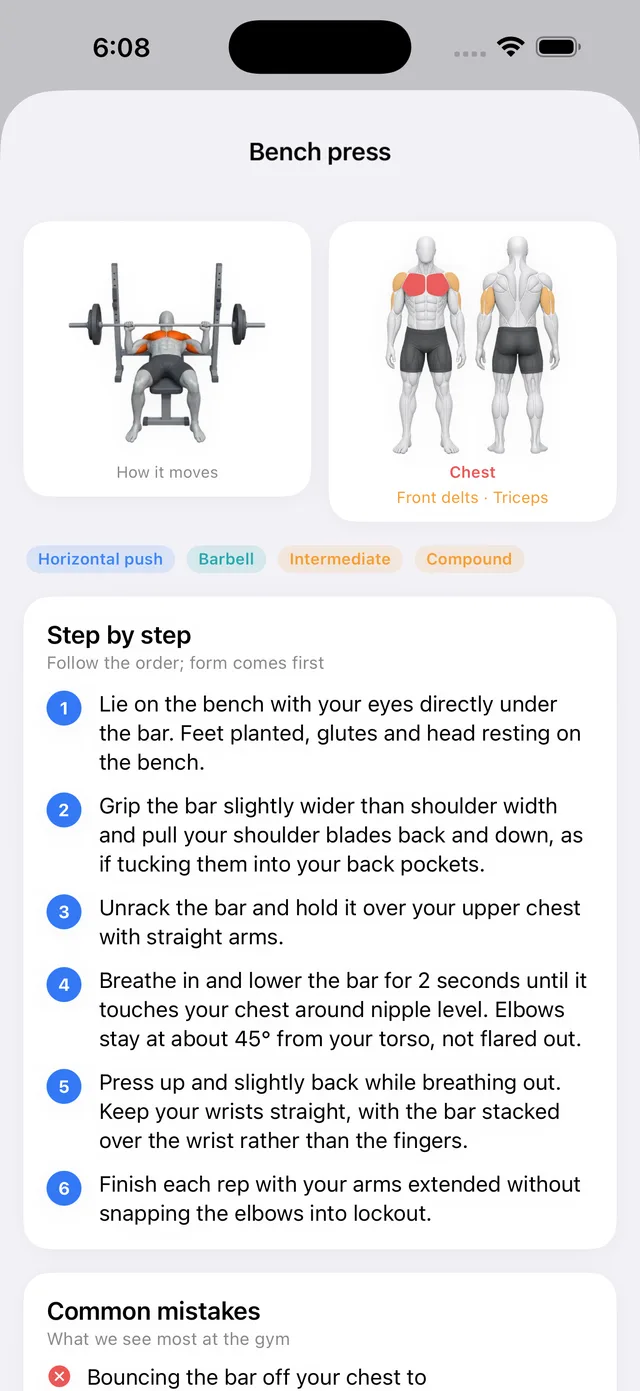
Most triathletes know they "should" do strength training. Far fewer actually do it, and the reason is rarely laziness. It is uncertainty. Which exercises? How heavy? Will it make my legs tired for Saturday's long ride? Is a gym session worth more than another hour on the bike?
This guide is meant to remove that uncertainty. It covers why strength work earns its place in a triathlon plan, how often to do it in each phase, two complete sessions you can use as they are, how to schedule them around your key swim, bike and run workouts, and the mistakes that make people quit. It is written for age-groupers and for strength training for triathlon beginners, not for people chasing a powerlifting total.
Why strength matters for triathletes
Let's be honest about what strength training can and cannot do. It will not replace swim, bike and run volume. You will not get faster in a 70.3 by skipping long rides to squat. But as a supporting habit, done consistently, there are good reasons to keep it in the week:
- Resilience. Running in particular loads your tendons, calves and hips thousands of times per session. Stronger tissues tolerate that load better. Strength work is not a guarantee against injury, but it is one of the few things within your control that tends to help.
- Economy. Research on endurance athletes has repeatedly found that heavy strength training can improve running and cycling economy, meaning you use a little less energy at the same pace. The effect is modest, but it is real and it comes without extra hours of cardio.
- Durability late in the race. The last 10 kilometres of a half or full distance are where form falls apart: hips drop, shoulders round, stride shortens. A stronger trunk and posterior chain help you hold position when you are tired. You still get tired. You just fall apart a bit later.
- Balance. Swimming, cycling and running are repetitive and mostly forward-moving. A little work on single-leg control, pulling and rotation covers the gaps they leave.
How many sessions per week, by phase
Strength follows the same logic as the rest of your plan: build when there is room, maintain when the endurance work gets specific, and back off before the race. If you are not sure what the phases are, our guide to planning your first half triathlon explains them.
- Base phase: 2 sessions per week. This is where strength gains are easiest to make, because endurance intensity is still low. Learn the movements, then gradually add load.
- Build phase: 1 to 2 sessions. Intervals and tempo work arrive, so the gym takes a step back. Keep the loads, drop a set if your legs feel heavy for key sessions.
- Specific phase: 1 light session. Fewer sets, same exercises, nothing new. The goal is to hold what you have, not to chase numbers.
- Taper: drop it, or keep it very light. Stop heavy lifting 10 to 14 days before the race. A few bodyweight movements and mobility are fine in race week if they help you feel normal.
If you are following a 16-week half Ironman training plan, that usually means two sessions for the first six to eight weeks and one after that.
A note on effort: RPE
The sessions below use RPE, the rate of perceived exertion, on a scale of 1 to 10. RPE 7 means you could have done about three more reps with good form. RPE 8 means about two more. For triathletes, most sets should sit between 6 and 8. You should finish a set feeling that it was hard work, not that you fought for the last rep. Failure is not the goal; quality is.
Session A: squat and hinge
This session focuses on the big lower-body patterns and a horizontal pull. It takes about 45 minutes with a 10-minute warm-up (easy cardio, leg swings, a few bodyweight squats and glute bridges).
| Exercise | Sets × reps | RPE | Rest |
|---|---|---|---|
| Goblet squat or back squat | 3 × 6–8 | 7 | 2 min |
| Romanian deadlift | 3 × 8 | 7 | 2 min |
| Rear-foot elevated split squat | 2 × 8 each leg | 7 | 90 s |
| One-arm dumbbell row | 3 × 10 each arm | 7 | 60 s |
| Single-leg calf raise (straight knee) | 3 × 12 each leg | 8 | 60 s |
| Dead bug | 3 × 8 each side | 6 | 45 s |
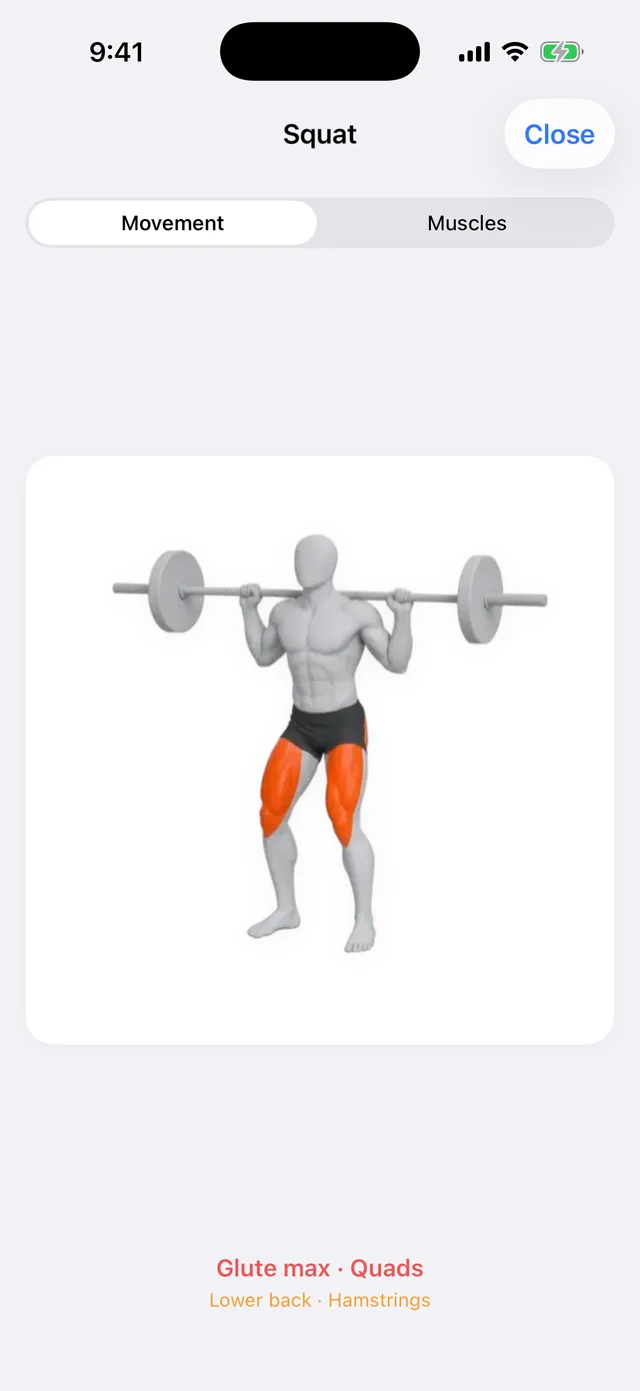
Start with the goblet squat. Holding a dumbbell at your chest keeps you upright and teaches depth without much risk. Move to a barbell back squat only when the goblet version is smooth and the dumbbell gets too heavy to hold. On the Romanian deadlift, think "push the hips back", not "bend down". The bar stays close to your legs and your back stays long.
Session B: single leg, push and trunk
Session B leans on single-leg strength, which carries over directly to running, plus a push and some anti-rotation work for the trunk. Same warm-up, similar length.
| Exercise | Sets × reps | RPE | Rest |
|---|---|---|---|
| Step-up (knee-height box) | 3 × 8 each leg | 7 | 90 s |
| Hip thrust | 3 × 8–10 | 7–8 | 90 s |
| Pull-up or lat pulldown | 3 × 5–8 | 7 | 2 min |
| Push-up or dumbbell bench press | 3 × 8–12 | 7 | 90 s |
| Bent-knee calf raise | 3 × 15 | 8 | 60 s |
| Pallof press | 3 × 10 each side | 6 | 45 s |
| Side plank | 2 × 30 s each side | 6 | 30 s |
Straight-knee calf raises in Session A and bent-knee raises in Session B work the two main calf muscles differently. Both matter for runners. If you cannot do a pull-up yet, use a band or the lat pulldown machine; it is the same pattern.
The best strength exercises for triathletes, sport by sport
You do not need a hundred exercises. A short list, done well for months, covers what swimming, cycling and running ask of your body. These are the ones in Sessions A and B, grouped by what they do for you:
- For running: single-leg calf raises (straight and bent knee), step-ups and split squats. Running is a long series of single-leg landings, so single-leg strength and strong calves and Achilles tendons carry over directly.
- For cycling: squats, Romanian deadlifts and hip thrusts. They train the hips and thighs that push the pedals, and the back that holds your position on the bike for hours.
- For swimming: pull-ups or lat pulldowns, rows and push-ups. Pulling strength helps your catch, and pushing keeps the shoulder balanced.
- For the trunk: dead bugs, Pallof presses and side planks. They teach your trunk to resist movement, which is what keeps your form together late in the race.
If you swim a lot, add a little shoulder care at the end of Session B: 2 sets of 15 band external rotations and 2 sets of 15 face pulls with a light band or cable. They take five minutes and train the small muscles at the back of the shoulder that freestyle tends to neglect.
Progression: technique first, then load
The first three or four weeks are for learning, not for loading. Pick weights that feel almost too easy, film a set now and then, and get the movement right. After that, progress one variable at a time:
- When you hit the top of the rep range at the target RPE for all sets, add a small amount of weight next time (2.5 to 5 kg on squats and deadlifts, the next dumbbell up elsewhere).
- If the new weight pushes you above the RPE target, stay there until it drops back.
- Write down what you lifted. Without a log, it is very hard to know whether you are progressing or just showing up.
In the build and specific phases, stop adding weight. Keep the loads you reached and reduce sets. That is how you hold on to strength while the swim, bike and run carry most of the load.
Weight lifting for triathletes: how heavy is heavy enough?
Triathletes tend to lift too light. Endurance training already gives your body plenty of long, easy repetitions; the gym is where you give it something different: a few reps against a real load. That is why the sessions above use 5 to 12 reps at RPE 7 to 8 rather than sets of 20.
A practical way to judge it: the last two reps of each set should slow down a little, but your form should look the same as on the first rep. If you could easily do five more, the weight is too light. If your back rounds or your knees cave in, it is too heavy. Machines are fine for the same patterns if free weights feel intimidating at first: the leg press, the lat pulldown and the cable row all count.
You will not end up looking like a bodybuilder. With eight or more hours a week of swim, bike and run, two short sessions make you stronger mostly through better coordination and stronger tendons, not big muscles. That is exactly what you want.
How to schedule strength around swim, bike and run
This is where most plans go wrong. A great squat session in the wrong place can wreck the workout that actually matters that week. A few rules keep things clean:
- Protect your key sessions. Keep heavy leg work at least 48 hours away from your long run and from quality run or bike sessions. Soreness from Romanian deadlifts is the last thing you want in the middle of tempo intervals.
- Pair hard with hard, easy with easy. Lifting on the same day as an interval session, a few hours after it, often works better than lifting on an "easy" day. That way your easy days stay truly easy.
- Endurance first when it matters. If you do both in one day, put the more important session first. Six hours or more between them is ideal; a short easy swim straight after lifting is fine.
- Swim days are friendly. A lift before or after an easy swim is often the simplest fit, since swimming barely touches your legs.
A simple example for a base week: Session A on Tuesday after a short swim, Session B on Friday, long ride Saturday, long run Sunday. If Friday's lift makes Sunday's run heavy, move it to Thursday. If time is the real problem, our piece on triathlon training with a full-time job has more ideas.
Mobility: ten minutes, not an hour
You do not need a separate mobility program. You need enough range to do the exercises well and to hold a decent position on the bike. Ten minutes a few times a week covers most people: hip flexor stretch, thoracic rotations, ankle mobility against a wall, and some shoulder work before swims. Add them to your warm-up or do them in the evening. Consistency matters more than the specific drill.
No gym? No problem
A pair of adjustable dumbbells, a resistance band and a sturdy chair will get you most of the way there. Swap in:
- Goblet squat with a dumbbell or a loaded backpack.
- Single-leg Romanian deadlift instead of the barbell version.
- Bulgarian split squat with your back foot on the sofa.
- Step-ups onto a stair or a stable chair.
- Single-leg glute bridge instead of the hip thrust.
- Band rows and push-ups for the upper body.
- Calf raises on a step, one leg at a time.
Without heavy weights, go slower on the way down, add a pause at the bottom, and use single-leg versions to make the work harder.
Common mistakes
- Treating the gym like a second cardio session. Circuits with no rest leave you tired without making you much stronger. Rest between sets. It is part of the plan.
- Going too light for too long. Three sets of 20 with a small dumbbell feels safe, but it does not give your tendons and muscles a reason to adapt. After the learning weeks, lift something that feels challenging.
- Going too heavy too soon. The opposite problem. Sore legs for four days will cost you more training than the session gave you.
- Changing the exercises every week. Progress comes from doing the same movements long enough to get better at them.
- Dropping it the moment training gets busy. One short session is much better than zero. Keep the habit, even if it is only 25 minutes.
- Ignoring pain. Normal muscle soreness is fine. Sharp, joint or worsening pain is not. If something hurts during or after lifting, stop that exercise and get it checked by a qualified physiotherapist or coach before you keep going.
Frequently asked questions
What are the best strength exercises for triathletes?
Squats, Romanian deadlifts, step-ups or split squats, hip thrusts, calf raises, pull-ups or rows, push-ups and a few trunk exercises such as dead bugs and side planks. Together they cover what swimming, cycling and running ask of your body, in two sessions of about 45 minutes.
Will lifting weights make me bulky or slow?
Very unlikely. Two short sessions a week on top of eight or more hours of endurance training is not a recipe for big muscle gain. What you build is mostly stronger tendons, better coordination and more force from the muscle you already have.
Should I do strength before or after a swim, bike or run on the same day?
If the endurance session is the key one, do it first and lift later, ideally with a few hours in between. If it is an easy spin or swim, the order matters less. Avoid heavy leg work right before a quality run or long ride.
How long should a triathlon gym workout take?
Around 40 to 50 minutes including a warm-up is enough. Five to seven exercises, two to four sets each, with rest between sets. Longer sessions tend to eat into the recovery your swim, bike and run need.
Can I keep strength training during race week?
Most athletes stop heavy lifting 10 to 14 days out. In race week, some light bodyweight work and mobility is fine if it helps you feel normal, but nothing that leaves you sore.
Where HalfTri fits
Strength is the part of triathlon training where people most often feel lost, so it is where we put a lot of care. In HalfTri, every one of the 700+ exercises shows how it moves in a 3D animation and which muscles it works on a muscle map, so gym days stop being guesswork. Rest timers run between sets and the app keeps a log of your last weights, so you know where to start next time.
You pick a race — sprint, Olympic, 70.3 or full distance — and its date. The app counts backwards, places you in the right phase and lays out every week, with gym sessions alongside swim, bike and run. It works with Apple Watch and includes race-day guides that work offline. The download is free, and HalfTri Pro unlocks the full plan, with 7 days free on the annual plan. An account is optional: without one, your data stays on your iPhone and in your iCloud.