 HalfTri
Triathlon training with a full-time job: the real hours Entrenar triatlón con un trabajo a tiempo completo: las horas reales
How many hours a week you actually need for each distance, what to protect when work eats your calendar, and three sample weeks built around a normal job. Cuántas horas por semana necesitas de verdad para cada distancia, qué proteger cuando el trabajo se come tu agenda y tres semanas de ejemplo pensadas para una vida con oficina.
Most triathletes are not professionals. They are accountants, nurses, teachers and software engineers who fit three sports around a job, a commute and people who would like to see them at dinner. If that is you, the question is not whether you can train for a triathlon. It is how many hours it really takes, and where those hours come from.
The honest answer is: fewer than the internet suggests, and they have to come from the same places every week. Time-crunched triathlon training is less about finding more time and more about deciding, in advance, what is non-negotiable.
How many hours a week do you really need?
These are conservative ranges for an amateur whose goal is to finish comfortably, not to qualify for anything. They describe a typical training week in the middle of a plan. The first weeks are lighter, and a few peak weeks sit at the top of the range or a little above it.
- Sprint (750 m / 20 km / 5 km): 3 to 5 hours a week. Four or five short sessions are enough.
- Olympic (1.5 km / 40 km / 10 km): 5 to 7 hours a week. The long ride reaches around 90 minutes.
- 70.3 or half ironman (1.9 km / 90 km / 21.1 km): 6 to 10 hours a week, peaking at 10 to 12 for two or three weeks. The long ride grows to 3 hours or so, the long run to around 1 hour 45.
- Full distance (3.8 km / 180 km / 42.2 km): 10 to 15 hours a week, with peaks that go higher. This is where a full-time job starts to need real negotiation at home.
So if you are asking how many hours a week to train for a half ironman, the practical number for most working people is an average of 7 to 8. That is roughly an hour a day, with the weekend doing the heavy lifting. If you want the full week-by-week structure, our 16-week half ironman training plan shows how the volume builds.
The minimum effective week
Some weeks, work wins. A launch, a sick child, a quarterly close. The mistake is treating those weeks as all or nothing. Instead, decide now what the smallest useful week looks like, so you already know what to protect when the calendar collapses.
For a 70.3, the minimum effective week is three sessions:
- The long ride. It builds the endurance you will need for the longest part of the race. Even shortened to two hours, keep it.
- The long run. It keeps your legs used to time on feet. Sixty to ninety easy minutes.
- One quality swim. Not the longest one: the one with drills or steady intervals. Swimming skill fades faster than bike or run fitness.
That is about four to five hours. Do those three and a hard week becomes a light week, not a lost one. Everything else (the second swim, the short runs, strength) is valuable, but it is the first thing to go when time runs out.
Three sample weeks: 6, 8 and 10 hours
These weeks assume a standard office job, Monday off, and weekends free in the morning. Swap days freely; the pattern matters more than the order. Early means before work, lunch means a 45 to 60 minute window in the middle of the day.
The 6-hour week
Good for sprint and Olympic builds, or for a 70.3 base phase and recovery weeks.
| Day | Session | Time |
|---|---|---|
| Monday | Rest | — |
| Tuesday | Early swim: drills and steady sets | 45 min |
| Wednesday | Early easy run | 40 min |
| Thursday | Lunch strength or indoor bike intervals | 40 min |
| Friday | Rest or 20 min mobility | — |
| Saturday | Long ride | 2 h |
| Sunday | Long run | 1 h 15 |
The 8-hour week
The sweet spot for most first 70.3s. Two swims, one run commute, one short brick.
| Day | Session | Time |
|---|---|---|
| Monday | Rest | — |
| Tuesday | Early swim: technique and intervals | 50 min |
| Wednesday | Early indoor bike with intervals · lunch strength | 60 + 30 min |
| Thursday | Run commute home, easy | 45 min |
| Friday | Lunch swim, steady endurance | 40 min |
| Saturday | Long ride + 15 min run off the bike | 2 h 30 + 15 min |
| Sunday | Long run | 1 h 20 |
The 10-hour week
A peak week for a 70.3. Do not live here; visit for two or three weeks, then back off.
| Day | Session | Time |
|---|---|---|
| Monday | Rest or easy lunch swim | 30 min |
| Tuesday | Early swim: race-pace sets · lunch strength | 60 + 30 min |
| Wednesday | Early indoor bike: tempo intervals | 1 h 15 |
| Thursday | Run commute with a steady middle section | 50 min |
| Friday | Early swim, endurance | 45 min |
| Saturday | Long ride + run off the bike | 3 h + 20 min |
| Sunday | Long run | 1 h 30 |
The run after Saturday's ride is a brick. It does not need to be long to work; here is why bricks matter and how to fit them in.
Tactics that give you time back
Train in the morning
Evening sessions compete with meetings that run late, tired legs and dinner. Morning sessions compete only with your alarm. If you can get to bed a bit earlier, an early start is the most reliable slot most working people have.
Run commute
If you live within 5 to 10 km of work, running home turns commute time into training time. Leave clothes and toiletries at the office on Monday, run with a light backpack, and take the train in the morning.
Use an indoor trainer
An hour on a trainer at 6 a.m. is worth more than the outdoor ride you keep postponing. No traffic, no daylight problem, no getting lost. Keep the bike set up so starting takes two minutes.
Time the pool
Find out when lanes are quietest, often right at opening or early afternoon, and anchor your swims there. A crowded lane turns a 45-minute set into an hour of waiting.
Lift at lunch
Strength for triathletes does not need 90 minutes. Two 30-minute sessions of squats, hinges, single-leg work and core are plenty. Our guide to strength training for triathletes covers what to include.
Pack the bag the night before
Goggles, cap, towel, lock, breakfast. The morning session is usually lost at 9 p.m., not at 6 a.m. Deciding nothing at dawn is the whole trick.
Family and partner logistics
A triathlon plan is a household plan. Sit down with your partner before you start and put the long sessions on the shared calendar: which morning is the long ride, which is the long run, and what you are taking on in return. Early starts on weekends mean you are home by mid-morning with the day still ahead. Some couples trade: one long session each on alternating mornings. Say out loud when race day is and what the last month will look like, because the peak weeks are when goodwill runs thin.
Sleep is training
Adaptation happens while you sleep, not while you train. If you are getting up at 5:30 to swim but going to bed at midnight, you are borrowing from next week. Treat seven to eight hours as part of the plan. When you must choose between an early session and sleep after a bad night, choose sleep and move the session.
Travel weeks and lost weeks
Travel weeks are best treated as run weeks. Shoes pack easily, hotels have treadmills and a small gym, and a 30-minute run is a good way to see a new city. Add a bodyweight strength routine and call it a planned lighter week.
A lost week, from illness or a work crisis, costs less fitness than it feels like. Do not try to make it up. Rejoin the plan where the calendar says you are, keep the first few days easy, and trim the next long sessions a little. If you are sick with anything below the neck, rest until it is gone.
When to skip and when to move
A simple rule: move the key sessions, skip the extras. If the long ride cannot happen on Saturday, move it to Sunday and shift the long run. If Wednesday's short run disappears, let it go. Never stack two missed hard sessions into one day, and never do the long ride and long run back-to-back just to catch up. If you are exhausted, sick or sleeping badly for more than two nights, skip without guilt.
If your race date itself changes, rebuild from the new date rather than stretching the old plan. That is one of the things we wanted HalfTri to handle: change the race and the plan re-adjusts on its own, counting backwards from the new day.
Where HalfTri fits
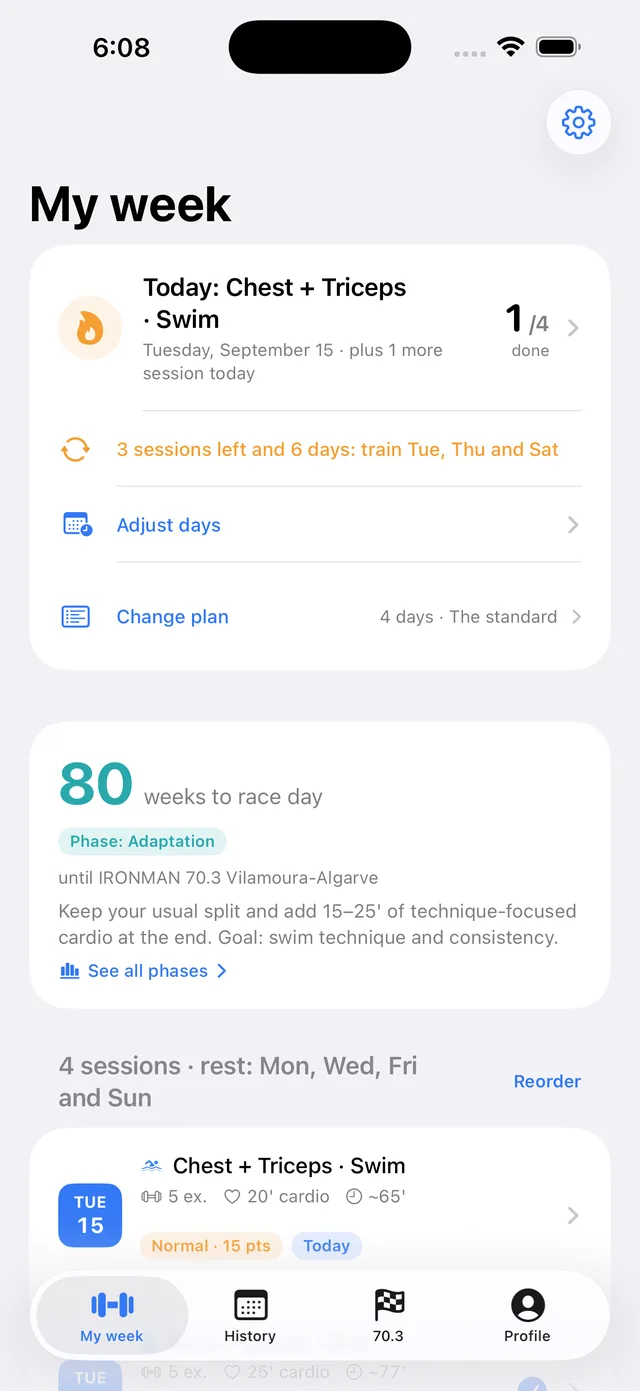
HalfTri is built for people who train around a job. You pick a race (sprint, Olympic, 70.3 or full distance) and its date, and the app counts backwards, places you in the right phase and lays out every week with gym, swim, bike and run sessions. Strength days include 108 exercises with 3D animations and muscle maps, rest timers and a log of your last weights. The Apple Watch companion means your phone can stay in the locker at the pool, and the race-day guides work offline.
It is a one-time purchase with no subscription and no account. Your data stays on your iPhone and in your iCloud. If you are just getting started, read how to plan your first half triathlon first.
FAQ
How many hours a week do I need to train for a half ironman?
For an amateur aiming to finish, most weeks sit between 6 and 10 hours, with a few peak weeks near 10 to 12. Many people finish a 70.3 comfortably on an average of 7 to 8 hours, as long as the long ride and long run happen almost every week.
Can I train for a triathlon working 50 hours a week?
Yes for a sprint or Olympic distance, and usually for a 70.3 if you give yourself more weeks. Choose a race 20 or more weeks away, protect the minimum effective week and accept that some weeks will only be that.
Is it better to train in the morning or after work?
Whichever you can repeat. For most people with a full-time job, early mornings are more reliable because meetings and fatigue have not happened yet. Evenings work if your calendar is predictable and the session does not ruin your sleep.
What should I do if I miss a whole week of training?
Do not try to make it up. Pick up the plan where the calendar says you are, make the first two or three days easy, and keep the next long ride and long run a little shorter. One lost week costs very little fitness; cramming it back is what causes injuries.
La mayoría de triatletas no son profesionales. Son contadores, enfermeras, profesores e ingenieros que encajan tres deportes entre el trabajo, el tráfico y la gente que quiere verlos a la hora de la cena. Si ese es tu caso, la pregunta no es si puedes entrenar para un triatlón. Es cuántas horas hacen falta de verdad y de dónde las vas a sacar.
La respuesta honesta: menos de las que sugiere internet, y tienen que salir de los mismos huecos cada semana. Entrenar con poco tiempo no va de encontrar más horas, sino de decidir de antemano qué no se negocia.
¿Cuántas horas por semana necesitas de verdad?
Estos rangos son conservadores y pensados para alguien amateur que quiere terminar tranquilo, no clasificar a nada. Describen una semana típica a mitad del plan. Las primeras semanas son más ligeras, y unas pocas semanas pico llegan al tope del rango o un poco más.
- Sprint (750 m / 20 km / 5 km): de 3 a 5 horas por semana. Cuatro o cinco sesiones cortas bastan.
- Olímpico (1,5 km / 40 km / 10 km): de 5 a 7 horas. La salida larga en bici llega a unos 90 minutos.
- 70.3 o medio ironman (1,9 km / 90 km / 21,1 km): de 6 a 10 horas, con dos o tres semanas pico de 10 a 12. La bici larga crece hasta unas 3 horas y la tirada larga hasta cerca de 1 h 45.
- Distancia completa (3,8 km / 180 km / 42,2 km): de 10 a 15 horas, con picos más altos. Aquí es donde un trabajo a tiempo completo empieza a pedir negociación seria en casa.
Así que, si te preguntas cuántas horas entrenar para un medio ironman, el número práctico para la mayoría de gente con trabajo es una media de 7 a 8. Más o menos una hora al día, con el fin de semana cargando con lo pesado. Si quieres la estructura semana a semana, nuestro plan de 16 semanas para medio ironman muestra cómo sube el volumen.
La semana mínima que sí cuenta
Hay semanas en que gana el trabajo. Un lanzamiento, un hijo enfermo, un cierre de trimestre. El error es vivirlas como todo o nada. Mejor decide hoy cómo es la semana más pequeña que todavía sirve, para saber qué proteger cuando la agenda se venga abajo.
Para un 70.3, esa semana mínima son tres sesiones:
- La bici larga. Construye la resistencia para la parte más larga de la carrera. Aunque la recortes a dos horas, mantenla.
- La tirada larga. Mantiene tus piernas acostumbradas a pasar tiempo corriendo. De sesenta a noventa minutos suaves.
- Una natación de calidad. No la más larga: la de técnica o series constantes. La destreza en el agua se pierde antes que la forma en bici o corriendo.
Son unas cuatro o cinco horas. Si cumples esas tres, una semana difícil se convierte en una semana ligera, no en una semana perdida. Todo lo demás (la segunda natación, los rodajes cortos, la fuerza) suma, pero es lo primero que se cae cuando no hay tiempo.
Tres semanas de ejemplo: 6, 8 y 10 horas
Estas semanas suponen un horario de oficina normal, el lunes libre y las mañanas del fin de semana disponibles. Cambia los días como te convenga; importa más el patrón que el orden. "Temprano" es antes del trabajo; "almuerzo", una ventana de 45 a 60 minutos a mediodía.
La semana de 6 horas
Sirve para preparar un sprint o un olímpico, o para la fase de base y las semanas de descarga de un 70.3.
| Día | Sesión | Tiempo |
|---|---|---|
| Lunes | Descanso | — |
| Martes | Natación temprano: técnica y series suaves | 45 min |
| Miércoles | Rodaje suave temprano | 40 min |
| Jueves | Fuerza al almuerzo o series en rodillo | 40 min |
| Viernes | Descanso o 20 min de movilidad | — |
| Sábado | Bici larga | 2 h |
| Domingo | Tirada larga | 1 h 15 |
La semana de 8 horas
El punto justo para la mayoría de primeros 70.3. Dos natas, una vuelta a casa corriendo y un brick corto.
| Día | Sesión | Tiempo |
|---|---|---|
| Lunes | Descanso | — |
| Martes | Natación temprano: técnica y series | 50 min |
| Miércoles | Rodillo temprano con series · fuerza al almuerzo | 60 + 30 min |
| Jueves | Volver a casa corriendo, suave | 45 min |
| Viernes | Natación al almuerzo, resistencia | 40 min |
| Sábado | Bici larga + 15 min corriendo al bajarte | 2 h 30 + 15 min |
| Domingo | Tirada larga | 1 h 20 |
La semana de 10 horas
Una semana pico de 70.3. No es para vivir en ella: visítala dos o tres semanas y luego baja.
| Día | Sesión | Tiempo |
|---|---|---|
| Lunes | Descanso o natación suave al almuerzo | 30 min |
| Martes | Natación temprano a ritmo de carrera · fuerza al almuerzo | 60 + 30 min |
| Miércoles | Rodillo temprano: series de tempo | 1 h 15 |
| Jueves | Volver a casa corriendo con un tramo a ritmo | 50 min |
| Viernes | Natación temprano, resistencia | 45 min |
| Sábado | Bici larga + carrera al bajarte | 3 h + 20 min |
| Domingo | Tirada larga | 1 h 30 |
Esa carrera después de la bici del sábado es un brick. No tiene que ser larga para funcionar; aquí te contamos por qué importan los bricks y cómo encajarlos.
Tácticas para recuperar tiempo
Entrena por la mañana
Las sesiones de la tarde compiten con reuniones que se alargan, piernas cansadas y la cena. Las de la mañana solo compiten con el despertador. Si consigues acostarte un poco antes, madrugar es el hueco más fiable que tiene casi cualquier persona con trabajo.
Ve o vuelve corriendo
Si vives a 5 o 10 km del trabajo, volver a casa corriendo convierte el trayecto en entrenamiento. Deja ropa y neceser en la oficina el lunes, corre con una mochila ligera y usa el transporte por la mañana.
Usa un rodillo
Una hora de rodillo a las 6 de la mañana vale más que la salida al aire libre que llevas semanas aplazando. Sin tráfico, sin depender de la luz, sin perderte. Deja la bici montada para que empezar te cueste dos minutos.
Elige bien la hora de la piscina
Averigua cuándo están más vacías las calles, a menudo justo al abrir o a primera hora de la tarde, y fija ahí tus natas. Una calle llena convierte una serie de 45 minutos en una hora de espera.
Fuerza al mediodía
La fuerza para triatletas no necesita 90 minutos. Dos sesiones de 30 minutos con sentadillas, bisagra de cadera, trabajo a una pierna y core son suficientes. Nuestra guía de fuerza para triatletas explica qué incluir.
Prepara la bolsa la noche anterior
Gafas, gorro, toalla, candado, desayuno. La sesión de la mañana casi siempre se pierde a las 9 de la noche, no a las 6 de la mañana. No tener que decidir nada al amanecer es todo el truco.
Pareja y familia
Un plan de triatlón es un plan de casa. Antes de empezar, siéntate con tu pareja y pon las sesiones largas en el calendario compartido: qué mañana es la bici larga, cuál la tirada larga y qué asumes tú a cambio. Salir temprano el fin de semana significa estar en casa a media mañana con el día por delante. Hay parejas que se turnan: una sesión larga cada uno en mañanas alternas. Di en voz alta cuándo es la carrera y cómo será el último mes, porque en las semanas pico es cuando la paciencia se agota.
Dormir también es entrenar
El cuerpo se adapta mientras duermes, no mientras entrenas. Si te levantas a las 5:30 para nadar pero te acuestas a medianoche, le estás pidiendo prestado a la semana siguiente. Trata las siete u ocho horas como parte del plan. Si después de una mala noche tienes que elegir entre madrugar y dormir, duerme y mueve la sesión.
Semanas de viaje y semanas perdidas
Las semanas de viaje funcionan mejor como semanas de correr. Las zapatillas caben en cualquier maleta, los hoteles suelen tener cinta y un gimnasio pequeño, y 30 minutos corriendo son una buena forma de conocer una ciudad. Suma una rutina de fuerza con tu peso corporal y considérala una semana ligera planificada.
Una semana perdida, por enfermedad o por una crisis en el trabajo, cuesta menos forma de la que parece. No intentes recuperarla. Vuelve al plan donde diga el calendario, haz suaves los primeros días y recorta un poco las siguientes sesiones largas. Si lo que tienes está por debajo del cuello, descansa hasta que se pase.
Cuándo saltar y cuándo mover
Una regla sencilla: mueve las sesiones clave, sáltate las extras. Si la bici larga no puede ser el sábado, pásala al domingo y desplaza la tirada larga. Si el rodaje corto del miércoles desaparece, déjalo ir. Nunca juntes dos sesiones duras perdidas en un mismo día, y nunca encadenes bici larga y tirada larga solo para ponerte al día. Si llevas más de dos noches agotado, enfermo o durmiendo mal, sáltala sin culpa.
Si lo que cambia es la fecha de la carrera, reconstruye desde la nueva fecha en lugar de estirar el plan viejo. Es una de las cosas que quisimos que HalfTri resolviera: cambias la carrera y el plan se reajusta solo, contando hacia atrás desde el nuevo día.
Dónde encaja HalfTri
HalfTri está pensado para quien entrena alrededor de un trabajo. Eliges una carrera (sprint, olímpico, 70.3 o distancia completa) y su fecha, y la app cuenta hacia atrás, te ubica en la fase correcta y te arma cada semana con sesiones de gimnasio, natación, bici y carrera. Los días de fuerza incluyen 108 ejercicios con animaciones 3D y mapas musculares, cronómetros de descanso y el registro de tus últimos pesos. Con el compañero de Apple Watch, el teléfono se puede quedar en la taquilla de la piscina, y las guías del día de carrera funcionan sin conexión.
Es un solo pago, sin suscripción y sin cuenta. Tus datos se quedan en tu iPhone y en tu iCloud. Si estás empezando, lee primero cómo planear tu primer medio triatlón.
Preguntas frecuentes
¿Cuántas horas por semana necesito para preparar un medio ironman?
Para alguien amateur que quiere terminar, la mayoría de semanas van de 6 a 10 horas, con algunas semanas pico de 10 a 12. Mucha gente termina un 70.3 sin sufrir con una media de 7 a 8 horas, siempre que la bici larga y la tirada larga se hagan casi todas las semanas.
¿Puedo entrenar para un triatlón trabajando 50 horas a la semana?
Sí para un sprint o un olímpico, y normalmente también para un 70.3 si te das más semanas. Elige una carrera a 20 semanas o más, protege la semana mínima y acepta que algunas semanas solo serán eso.
¿Es mejor entrenar por la mañana o después del trabajo?
El horario que puedas repetir. Para casi todo el que trabaja a tiempo completo, la mañana es más fiable porque todavía no han llegado ni las reuniones ni el cansancio. La tarde funciona si tu agenda es predecible y la sesión no te arruina el sueño.
¿Qué hago si pierdo una semana entera de entrenamiento?
No intentes recuperarla. Retoma el plan donde diga el calendario, haz suaves los dos o tres primeros días y acorta un poco la siguiente bici larga y la siguiente tirada larga. Una semana perdida cuesta muy poca forma; lo que lesiona es querer meterla de golpe.