 HalfTri
How to plan your first half triathlon (without spreadsheets) Cómo planear tu primer medio triatlón (sin hojas de cálculo)
Twelve to twenty weeks, three sports and a full-time life. Here is a simple, honest way to think about the plan — and the small decisions that make race day feel calm. De doce a veinte semanas, tres deportes y una vida a tiempo completo. Aquí tienes una forma sencilla y honesta de pensar el plan, y las pequeñas decisiones que hacen que el día de la carrera se sienta tranquilo.
Signing up for a half triathlon is the fun part. The next morning is when the questions start. How long does the plan need to be? How many days per week? Do I need a coach, a gym, a power meter, an open-water swim buddy? Should I be counting kilometres, hours, or heart rate?
You do not need all of that to finish your first 70.3. You need three things, in order: a race date, a plan that counts backwards from it, and a way to keep showing up on the days you feel like skipping. Everything else — the watches, the gels, the aero helmet — is optional.
Start with the finish line
The first mistake most first-timers make is picking a plan before picking a race. A plan without a date is a to-do list. It has no weight behind it. So the very first thing to lock in is a race date you can actually reach.
Give yourself between 12 and 20 weeks from where you are today. If you already swim, bike or run once or twice a week and you have finished at least a 10K or a sprint triathlon, 12 to 16 weeks is enough. If you are starting mostly from zero, aim for 20, and give yourself a base month first that is just consistency: three easy workouts a week, nothing heroic.
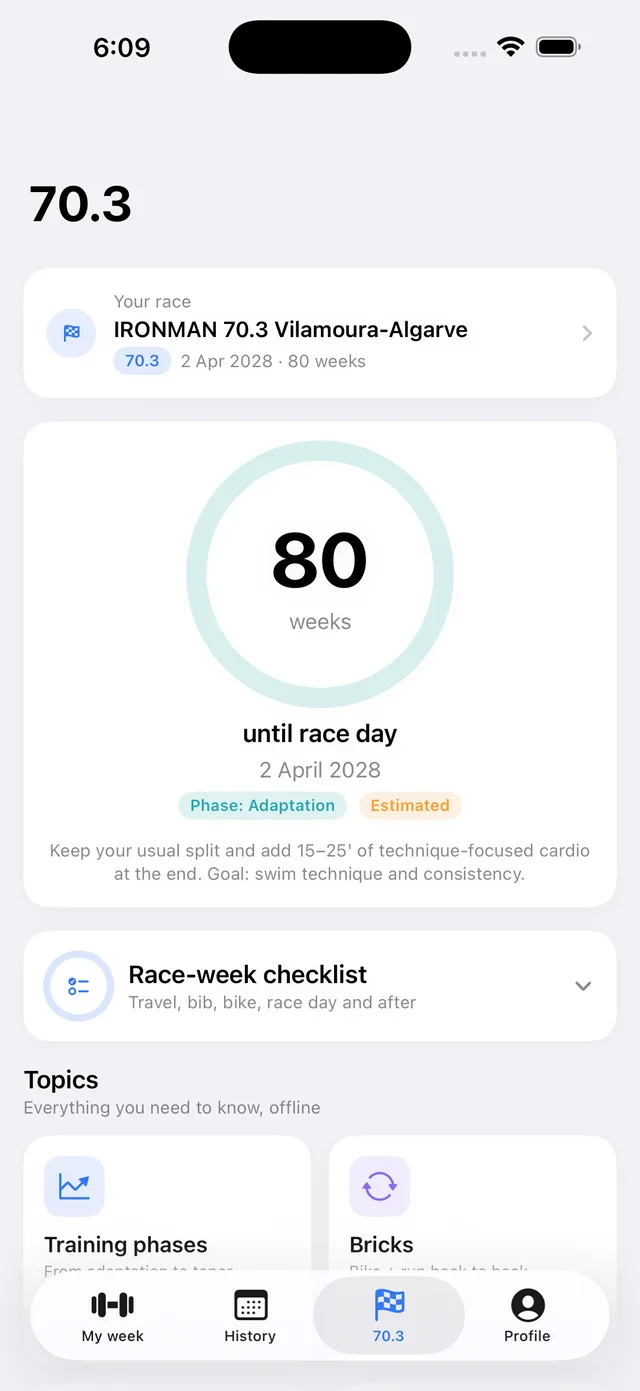
Then work backwards. The plan is not "what should I do this week?" — it is "what week am I in, counting from race day?"
The shape of the plan
Every honest half-triathlon plan we have seen is a variation of the same five phases:
- Adaptation. Two to four weeks of getting used to swimming, biking and running in the same week. Volume is low. The goal is habit, not fitness.
- Base. Six to eight weeks of easy, aerobic volume in all three sports. Long sessions get longer. Effort stays conversational.
- Build. Four to six weeks of adding intensity — intervals on the bike, tempo runs, race-pace swim sets. Volume plateaus so the body can absorb it.
- Specific. Two to three weeks of practicing the race itself: bricks, race-pace efforts, nutrition rehearsals, open-water swims.
- Taper. The last 10–14 days. Cut volume in half, keep a little intensity, sleep more.
You do not need to memorize the names. You just need to know which phase you are in this week, because it changes what "hard" and "easy" mean.
Three sports, four to six days
Most people trying to finish their first 70.3 while holding a job can train four to six days a week. Fewer than four and progress stalls; more than six and something breaks — the body, the schedule, or the person you live with.
A workable week for many first-timers looks like this:
- One long ride (the anchor of the week).
- One long run, moved to the day after the long ride only if you can handle it.
- Two swims — one technique, one endurance.
- One or two strength sessions, short and boring, focused on hips, core and posterior chain.
- One brick every 10–14 days: bike, then run off the bike for 15–30 minutes.
Rest is part of the plan, not the absence of it. If you take Monday off every week for a full block, you are training more, not less, because your Sunday long ride actually lands.
Skip the spreadsheet, keep the log
There is a strong pull to design the whole thing in a spreadsheet: sixteen weeks, five columns, colour-coded intensities. It feels productive. It also stops being true by week three.
What matters is not what you planned, it is what you did. Keep a simple log — even a note on your phone — for every session: the time, how it felt (1 to 10), and one line on why. In eight weeks you will see patterns the plan could never predict: how you sleep after a hard brick, what a bad Monday looks like, which workouts you keep skipping because they never fit your schedule.
Then move those workouts. A plan is a hypothesis. The log is the evidence.
Eat for the ride, not the race
A half triathlon is roughly 4 to 7 hours of racing for most amateurs. The finish is decided in the second half of the bike and the first half of the run — and that is where nutrition either holds up or falls apart.
Two habits pay off more than any gel brand:
- Practice eating on the bike, weekly. Every long ride is a nutrition rehearsal, not just a fitness session. If your stomach hates gels at hour two, better to find out in July than at the race.
- Aim for 60–90 grams of carbs per hour once you have practiced it. Not on day one. Build up: 40, 60, 80 across a few long rides.
Race-day nutrition is boring, on purpose. Nothing new, nothing spicy, nothing you have not eaten on a training ride at least three times.
The last week is a practice run, not a fitness test
You do not gain fitness in the final week. You lose it if you try. The taper exists to let the last months catch up with your legs.
Some things that quietly matter more than a last big workout:
- Sleep debt. Bank an extra hour a night for the whole taper. It compounds.
- Bike check, twice. Once at home, once on race-day-minus-one at the venue. Tyres, brakes, gears, bottle cages.
- Transition rehearsal. Lay out your bag in your living room. Time yourself putting on your helmet and running shoes. This alone will save you 60 seconds you would otherwise lose to panic.
- A dead-simple pace plan. One number per leg. Swim smooth. Ride effort, not speed. Run the first 5K slower than you feel.
What HalfTri does with all of this
We built HalfTri because we wanted the plan to stop being homework. You pick a race — sprint, Olympic, 70.3 or full — and the app counts backwards from the date, drops you into the right phase, and lays out every week for you. Change the race and everything shifts on its own.
Every exercise shows how it moves in 3D and which muscles it works, so strength days stop being guesswork. Sessions have rest timers, a place for your last weights, and an Apple Watch companion so your phone can stay in your pocket at the pool. The race-day guides — nutrition, checklist, transitions, open water — live inside the app and work offline.
It is a one-time purchase, no subscription, no account. Your training stays on your iPhone and in your iCloud.
Inscribirte en un medio triatlón es la parte divertida. La mañana siguiente empiezan las preguntas. ¿Cuánto tiene que durar el plan? ¿Cuántos días por semana? ¿Necesito entrenador, gimnasio, medidor de potencia, alguien para nadar en aguas abiertas? ¿Cuento kilómetros, horas o pulsaciones?
No necesitas nada de eso para terminar tu primer 70.3. Necesitas tres cosas, en este orden: una fecha de carrera, un plan que cuente hacia atrás desde ella y una forma de aparecer los días que no te apetece. Todo lo demás — el reloj, los geles, el casco aero — es opcional.
Empieza por la meta
El primer error de casi todos los debutantes es escoger un plan antes de escoger una carrera. Un plan sin fecha es una lista de tareas. No pesa. Así que lo primerísimo es cerrar una fecha de carrera realista.
Date entre 12 y 20 semanas desde hoy. Si ya nadas, ruedas o corres una o dos veces por semana y has terminado al menos un 10K o un triatlón sprint, con 12–16 semanas te alcanza. Si empiezas casi de cero, apunta a 20, y hazte antes un mes de base que sea solo constancia: tres entrenamientos suaves por semana, nada heroico.
Luego trabaja hacia atrás. El plan no es "¿qué toca esta semana?" — es "¿en qué semana estoy contando desde el día de la carrera?"
La forma del plan
Todo plan honesto de medio triatlón que hemos visto es una variación de las mismas cinco fases:
- Adaptación. Dos a cuatro semanas de acostumbrarte a nadar, rodar y correr en la misma semana. Volumen bajo. El objetivo es el hábito, no la forma.
- Base. Seis a ocho semanas de volumen aeróbico suave en los tres deportes. Las sesiones largas se van alargando. La intensidad se queda conversacional.
- Construcción. Cuatro a seis semanas de añadir intensidad — series en la bici, tempo corriendo, sets de natación a ritmo de carrera. El volumen se estabiliza para que el cuerpo lo asimile.
- Específico. Dos a tres semanas de ensayar la carrera: bricks, ritmos de carrera, ensayos de nutrición, aguas abiertas.
- Taper. Los últimos 10–14 días. Reduce el volumen a la mitad, mantén algo de intensidad, duerme más.
No hace falta memorizar los nombres. Solo tienes que saber en qué fase estás esta semana, porque cambia lo que significan "fuerte" y "suave".
Tres deportes, de cuatro a seis días
La mayoría de personas que intentan terminar su primer 70.3 con un trabajo a tiempo completo pueden entrenar de cuatro a seis días por semana. Menos de cuatro y el progreso se estanca; más de seis y algo se rompe — el cuerpo, la agenda, o la persona con la que vives.
Una semana que funciona para muchos debutantes se ve así:
- Una salida larga en bici (el ancla de la semana).
- Una tirada larga corriendo, movida al día siguiente de la bici larga solo si aguantas.
- Dos natas — una de técnica, otra de resistencia.
- Uno o dos días de fuerza, cortos y aburridos, enfocados en cadera, core y cadena posterior.
- Un brick cada 10–14 días: bici, y en cuanto bajas, correr 15–30 minutos.
El descanso es parte del plan, no su ausencia. Si dejas el lunes libre cada semana durante un bloque, estás entrenando más, no menos, porque la salida larga del domingo de verdad aterriza.
Olvídate de la hoja de cálculo, quédate con el registro
Da mucha gana diseñarlo todo en una hoja de cálculo: dieciséis semanas, cinco columnas, intensidades con colores. Se siente productivo. Y deja de ser verdad en la semana tres.
Lo que importa no es lo que planeaste, es lo que hiciste. Lleva un registro simple — aunque sea una nota en el teléfono — de cada sesión: el tiempo, cómo se sintió (del 1 al 10) y una línea del porqué. En ocho semanas verás patrones que el plan jamás pudo predecir: cómo duermes después de un brick fuerte, cómo se ve un lunes malo, qué entrenamientos siempre te saltas porque no encajan.
Y muévelos. Un plan es una hipótesis. El registro es la evidencia.
Come para la salida, no para la carrera
Un medio triatlón dura entre 4 y 7 horas para la mayoría de amateurs. El final se decide en la segunda mitad de la bici y la primera mitad de la carrera a pie — y ahí es donde la nutrición aguanta o se cae.
Dos hábitos pesan más que cualquier marca de gel:
- Practica comer en la bici, cada semana. Cada salida larga es un ensayo de nutrición, no solo una sesión física. Si tu estómago odia los geles a la segunda hora, mejor descubrirlo en julio que el día de la carrera.
- Apunta a 60–90 gramos de carbos por hora cuando ya lo hayas practicado. No el primer día. Sube poco a poco: 40, 60, 80 a lo largo de varias salidas largas.
La nutrición del día de la carrera es aburrida a propósito. Nada nuevo, nada picante, nada que no hayas comido en una salida de entrenamiento al menos tres veces.
La última semana es un ensayo, no una prueba de forma
No se gana forma en la última semana. Se pierde si lo intentas. El taper existe para que los últimos meses alcancen a tus piernas.
Cosas que en silencio importan más que un último entrenamiento fuerte:
- Deuda de sueño. Ahorra una hora extra por noche durante todo el taper. Se acumula.
- Revisión de bici, dos veces. Una en casa, otra en el lugar el día antes de la carrera. Neumáticos, frenos, cambios, portabidones.
- Ensayo de transición. Tiende tu bolsa en la sala. Cronométrate poniéndote el casco y las zapatillas. Solo eso te ahorra 60 segundos que perderías al entrar en pánico.
- Un plan de ritmo simple. Un número por segmento. Nada suave. Rueda por esfuerzo, no por velocidad. Corre los primeros 5K más lento de lo que te apetezca.
Qué hace HalfTri con todo esto
Construimos HalfTri porque queríamos que el plan dejara de ser tarea. Eliges una carrera — sprint, olímpico, 70.3 o completa — y la app cuenta hacia atrás desde la fecha, te ubica en la fase correcta y te arma cada semana. Si cambias de carrera, todo se reajusta solo.
Cada ejercicio muestra cómo se mueve en 3D y qué músculos trabaja, para que los días de fuerza dejen de ser adivinanza. Las sesiones tienen cronómetros de descanso, un espacio para tus últimos pesos y un compañero de Apple Watch, para que el teléfono se quede en el bolsillo en la piscina. Las guías del día de carrera — nutrición, checklist, transiciones, aguas abiertas — viven dentro de la app y funcionan sin conexión.
Es un solo pago, sin suscripción, sin cuentas. Tu entrenamiento se queda en tu iPhone y en tu iCloud.