 HalfTri
The ancient Greek gymnasium: what it was really like
Naked, covered in oil and dust, with coaches, written rules and philosophers strolling among the athletes. What the texts and archaeology tell us, and who tells it.
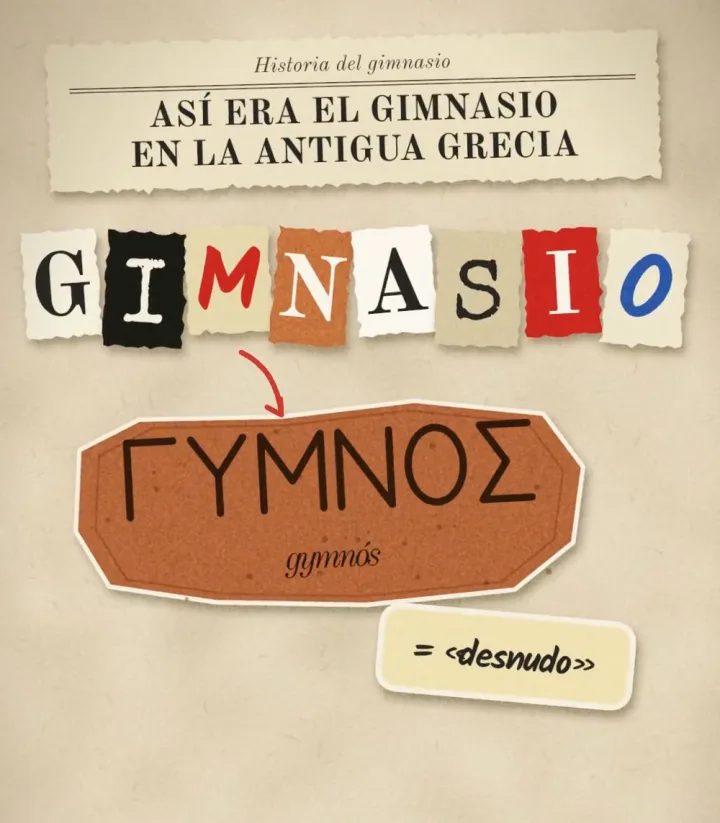
The gymnasium of ancient Greece was where people trained naked (the word comes from gymnós, “naked”), covered in olive oil and dust, with coaches and, at least in some cities, written rules. And it was not just for working up a sweat: Plato’s Academy and Aristotle’s Lyceum were gymnasia.
This is the long version of our short video, with the nuances that don’t fit into a minute. Many of the details were written by authors of the Roman era, centuries after classical Athens, so we tell you who says what, when, and what is legend.
Why is it called a “gym”?
It comes from the Greek gymnós, “naked.” According to the Liddell, Scott and Jones dictionary of ancient Greek, gymnázein meant to train naked, and gymnásion went from meaning the exercises to meaning the school of gymnastics and, in the end, any school, including schools of philosophy. That is why, in German, a Gymnasium is a secondary school today.
And it was literal. Thucydides, writing at the end of the 5th century BC, says the Spartans set the example by competing naked and oiled, and Plato, in the 4th century BC, recalls that not long before, the Greeks still found it shameful. In classical Greece, athletes trained and competed naked.
Who started competing naked?
The story often goes that a runner lost his loincloth in the middle of a race. But not even the Greeks themselves could agree:
- Pausanias, a Greek author of the 2nd century AD, writing almost nine centuries after the date tradition gives, says Orsippus of Megara won at Olympia without a loincloth, and believes he let it slip on purpose.
- Dionysius of Halicarnassus, a Greek historian who lived in Rome in the time of Augustus, says the first was a Spartan, Acanthus, at the 15th Olympiad (720 BC, by the traditional count).
- Thucydides talks about the Spartans, and says the loincloth was dropped at Olympia only “a few years” before, which does not fit such an early date.
- Plato says the Cretans started it, and then the Spartans.
What is certain is that it was not always this way: Dionysius himself points out that in Homer, wrestlers still girded something around their waists.
Why did they cover themselves in oil and dust?
Before training, they rubbed themselves with olive oil and sprinkled dust on top. Lucian, a satirical writer of the 2nd century AD, explains that the mud and dust were there so they could fall on something soft, and the dust also kept their grip from slipping in wrestling. By the 3rd century AD, Philostratus went as far as telling apart five kinds of dust, each with its supposed effect, but that is the theory of a late author.
Afterward, they scraped off the oil, sweat and dust with a strigil, a curved metal scraper. Many survive, such as a bronze one from the 5th–4th centuries BC at the Metropolitan Museum of Art in New York.
Were the gymnasium and the palaestra the same thing?
Not quite. The palaestra was the sand courtyard for wrestling, with rooms around it. The gymnasium was something bigger: a city institution, with its officials, its buildings and tracks for running, and the palaestra was usually one part of it. Vitruvius, a Roman architect of the 1st century BC, describes an ideal palaestra with a dust room, an oil room, a cold bath and a covered track for training in winter.
Remains survive too. At Delphi, the gymnasium, from the 4th century BC, had a covered track almost 186 meters long and a round pool 10 meters across; the hot bath came with the Romans. At Olympia, the gymnasium’s covered track, probably from the late Hellenistic period, measures about 192 meters, the same as the stadium.
Was the gymnasium only for exercise?
No. Plato’s Academy and Aristotle’s Lyceum were gymnasia on the outskirts of Athens. In the Lysis, Plato himself takes Socrates from the Academy to the Lyceum and has him stop at a new palaestra where the main pastime is conversation. About 600 years later, in the 3rd century AD, Diogenes Laertius writes that Aristotle taught while walking with his students through the Lyceum… until it was time to oil up.
Plato summed up traditional education as “gymnastics for the body and music for the soul,” and by music he also meant poetry and letters. That does not mean everyone went there to philosophize: plenty of people went just to train.
Were there coaches and rules?
Yes. According to Plato, parents sent their sons to a trainer, the paidotríbes, so that the body would obey the mind, and the sons of the richest started school earlier and left it later. Centuries later, Philostratus described another kind, the gymnastés, who also knew about diet and massage; that neat distinction is his own, from the Roman era.
And there were written rules. At Beroia, in Macedonia, a gymnasium law carved in stone, dating from between 200 and 165 BC, turned up in 1949. According to it:
- the gymnasiarch, who ran the gymnasium, had to be between 30 and 60 years old;
- the trainers had to come twice a day, with a fine of 5 drachmas for every day they missed;
- there were prizes for physical fitness, discipline and effort for those under 30;
- and slaves, freedmen and their sons, among others, could not train there.
That applies to Beroia and the 2nd century BC, not to all of Greece. In Athens, the orator Aeschines quoted, around 345 BC, a law that banned slaves from training in the palaestras.
Could women train?
In most of Greece, the gymnasium was for free men: when Plato proposes that women exercise in the palaestra, the person he is talking to replies that, as things stand, it would look ridiculous. Sparta was the best-known exception. According to Xenophon (4th century BC), women there competed in races and trials of strength just like men, and Plutarch, centuries later, adds wrestling, the discus and the javelin. At Olympia there were also races for young women in honor of Hera, according to Pausanias.
Did the Greeks train with weights?
Yes, though not like today. Jumpers held weights of stone or lead in their hands, the halteres. According to Philostratus, pentathletes invented them for the jump, and they were also used to train the shoulders and arms. According to a 2002 study published in Nature, the surviving pieces weigh between 2 and 9 kilograms and, based on a computer model and volunteers, they could add at least 17 centimeters to a 3-meter standing jump (we don’t know for sure how the ancient jump was done). While they jumped, according to Pausanias, an aulos played: a reed wind instrument, not a flute like today’s.
The Olympia Museum also holds a sandstone block weighing 143.5 kilograms, from the early 6th century BC according to the Greek Ministry of Culture’s record, with a boast carved into it: a man named Bybon says he heaved it over his head with one hand. That is what the stone says, not a verified record.
And the most famous wrestler of ancient Greece, Milo of Croton, is said to have trained by carrying a calf: here is how much of that story is true.
Did they follow a training plan?
Philostratus, in the 3rd century AD, describes the tetrads, four-day cycles: one day to prepare, one to push hard, one to ease off and one in between. It sounds modern, but it was not the method of classical Greece, and Philostratus criticizes it. He tells of Gerenus of Naucratis, a wrestler who had won at Olympia: he celebrated his victory, ate food he wasn’t used to and slept badly; his trainer would not let him skip the tetrad, and he died in training.
What does the Greek gymnasium tell us today?
Training, thinking and following rules: the Greek gymnasium was much more than a place to sweat. And some ideas sound very modern, like that of Galen, a Greek physician of the 2nd century AD: in a treatise, he praised playing with a small ball because, he said, the best exercise is the one that also lifts your spirits. It was an opinion, not a study.
If you want to bring the Greek gymnasium into your training, minus the oil and dust, start with strength: you’ll find ideas in our guide to strength training for triathletes. And if you are getting ready for your first 70.3, our 16-week plan helps you build up the load gradually.
Frequently asked questions
Why is it called a gym?
It comes from the Greek gymnós, “naked”: gymnázein meant to train naked, and gymnásion came to mean the place where people trained and, over time, any school, including schools of philosophy.
Did the ancient Greeks really train naked?
Yes. In classical Greece, athletes trained and competed naked, covered in oil; writers of the time such as Thucydides and Plato say so. Who started the custom, not even the Greeks themselves were sure.
What is a strigil?
A curved metal scraper that athletes used to remove oil, sweat and dust after training. Many survive, such as a bronze one from the 5th–4th centuries BC at the Metropolitan Museum of Art in New York.
What is the difference between a gymnasium and a palaestra?
The palaestra was the place for exercise and wrestling, a courtyard with rooms around it. The gymnasium was a larger institution, with running tracks and several buildings, and the palaestra was usually one part of it.
Did the ancient Greeks lift weights?
They used halteres, weights of stone or lead that jumpers held in their hands and that, according to Philostratus, were also used to train the shoulders and arms. Olympia also has a 143.5-kilogram stone whose inscription boasts that a man named Bybon heaved it over his head with one hand, something that cannot be verified.
Did women go to the gymnasium in ancient Greece?
In most of Greece, no: the gymnasium was for free men. Sparta was the best-known exception, with girls who ran and wrestled, and at Olympia there were races for young women in honor of Hera.
Did Plato and Aristotle teach in gymnasia?
Yes. Plato’s Academy and Aristotle’s Lyceum were gymnasia on the outskirts of Athens. According to Diogenes Laertius, Aristotle taught while walking with his students until it was time to oil up.
About the sources: almost everything we know about the Greek gymnasium comes from ancient texts, inscriptions and archaeological remains, and many of those texts were written in the Roman era, centuries after classical Greece. When ancient authors disagree, we say so. The texts are quoted in translation and paraphrased. The training part is for education and is not a substitute for medical advice. IRONMAN and 70.3 are registered trademarks of The IRONMAN Group; HalfTri is independent and is not affiliated with or endorsed by IRONMAN.
Sources
- Liddell, Scott & Jones, A Greek-English Lexicon, “γυμνάζω”: lsj.gr
- Liddell, Scott & Jones, A Greek-English Lexicon, “γυμνάσιον”: lsj.gr
- Duden, “Gymnasium”: www.duden.de
- Thucydides, trans. Crawley (Perseids), “History of the Peloponnesian War 1.6”: cts.perseids.org
- Plato, trans. Shorey (Perseids), “Republic, book 2 (376e)”: cts.perseids.org
- Plato, trans. Shorey (Perseids), “Republic, book 5 (452a-d)”: cts.perseids.org
- Plato, trans. Lamb (Perseids), “Lysis 203a-204a”: cts.perseids.org
- Plato, trans. Lamb (Perseids), “Protagoras 326b-c”: cts.perseids.org
- Pausanias, trans. Jones & Ormerod (Perseids), “Description of Greece 1.44.1”: cts.perseids.org
- Dionysius of Halicarnassus, trans. Cary (LacusCurtius), “Roman Antiquities 7.72”: penelope.uchicago.edu
- Dionysius of Halicarnassus, trans. Cary (LacusCurtius), “Roman Antiquities 1.3 and 1.7”: penelope.uchicago.edu
- Lucian, trans. Harmon (Perseids), “Anacharsis 1-20”: cts.perseids.org
- Lucian, trans. Harmon (Perseids), “Anacharsis 21-40”: cts.perseids.org
- Philostratus, ed. and trans. Daremberg (archive.org), “Philostrate, Traité sur la gymnastique” (1858): archive.org
- The Metropolitan Museum of Art, “Bronze strigil (14.105.2)”: www.metmuseum.org
- U. Mania, Edition Topoi, “Gymnasial Buildings and Sanctuaries (Development of Gymnasia and Graeco-Roman Cityscapes)” (2018): www.edition-topoi.org
- Vitruvius, trans. Gwilt (LacusCurtius), “On Architecture 5.11”: penelope.uchicago.edu
- Ephorate of Antiquities of Phocis, Hellenic Ministry of Culture, “Delphi: the gymnasium”: delphi.culture.gr
- Diogenes Laertius, trans. Hicks (Perseids), “Lives of Eminent Philosophers 3 (Plato)”: cts.perseids.org
- Diogenes Laertius, trans. Hicks (Perseids), “Lives of Eminent Philosophers 5 (Aristotle)”: cts.perseids.org
- Ch. Kouklidis, International Journal of Wrestling Science, “Regulating an ancient Greek gymnasium and palaestra (the gymnasiarchal law of Beroia)” (2019): academy.uww.org
- Aeschines (Perseids, Greek text), “Against Timarchus 138”: cts.perseids.org
- Xenophon, trans. Marchant (Perseids), “Constitution of the Lacedaemonians 1.4”: cts.perseids.org
- Plutarch, trans. Perrin (Perseids), “Life of Lycurgus 14”: cts.perseids.org
- Pausanias, trans. Jones & Ormerod (Perseids), “Description of Greece 5.16.2-3 (the Heraea)”: cts.perseids.org
- Pausanias, trans. Jones & Ormerod (Perseids), “Description of Greece 5.7.10 (the aulos)”: cts.perseids.org
- Minetti & Ardigò, Nature, “Halteres used in ancient Olympic long jump” (2002): doi.org
- Scientific American, “Hand Weights Enhanced Ancient Athletes' Performances” (2002): www.scientificamerican.com
- Hellenic Ministry of Culture, Odysseus (archived copy), “Archaeological Museum of Olympia: the stone of Bybon”: web.archive.org
- C. A. Gibson, Greek, Roman, and Byzantine Studies, “Encomium and Thesis in Galen's De parvae pilae exercitio” (2014): grbs.library.duke.edu